Simply put, an angel sculpture meaning is commonly associated with protection, faith, hope, peace, remembrance, spiritual guidance, and blessing. An angel sculpture is therefore more than a decorative work of art; it can also become a visual expression of human emotion, memory, belief, and aspiration.
However, not every angel statue carries exactly the same message. A flying angel may suggest freedom and spiritual ascent, while a sleeping angel can express peace and remembrance. A praying angel may represent faith, devotion, or blessing. Pose, wings, facial expression, gesture, material, and location can all influence how we interpret the meaning of an angel sculpture.
This guide explores where angel imagery came from, how its symbolism changed through art history, what famous angel sculptures represent, and how to choose an angel design that communicates the emotion or message you want to express.
Table of Contents
- 1. Angel Sculpture Meaning: The Origin of the Angel Image
- 2. Angel Sculpture Meaning Through Art History
- 4. Angel Sculpture Meaning in Famous Works Around the World
- 5. Angel Sculpture Meaning by Pose, Wings, and Expression
- 6. Angel Sculpture Meaning in Three New D&Z Designs
- 7. How to Choose an Angel Sculpture by Meaning
- 8. How Material Influences Angel Sculpture Meaning
- 9. FAQs About Angel Sculpture Meaning
- 10. Why Angel Sculpture Meaning Endures Across Generations
1. Angel Sculpture Meaning: The Origin of the Angel Image
The familiar winged human figure we recognize as an angel today was not created all at once.
In Western religious and artistic traditions, angel imagery developed mainly from Jewish and Christian scripture, where angels commonly appear as messengers, guardians, or heavenly beings. Yet early descriptions do not always match the large feathered-wing figures seen in later European art. Biblical cherubim and seraphim can possess wings, while many messenger-like angels are presented in human form.
Early Christian artists likewise often represented angels as human figures without wings. Winged angels became increasingly established in Christian art in late antiquity, and over the following centuries artists developed the visual language now associated with angels: feathered wings, halos, flowing robes, musical instruments, and celestial settings.
These visual elements gradually became symbolic.
Wings suggested a connection between earth and heaven. A halo emphasized sacred or spiritual character. Musical instruments could suggest heavenly harmony. Protective poses suggested guardianship, while upward movement communicated transcendence and hope.
This evolution explains why the angel figure sculpture we recognize today carries meanings that extend far beyond its physical form.
2. Angel Sculpture Meaning Through Art History
The symbolism of angel sculpture has never remained completely fixed. Artists in different periods reshaped the angel according to changing religious beliefs, artistic styles, and human emotions.
Early Christian and Medieval Art
Early Christian angels were primarily connected with divine messages, faith, heavenly authority, and spiritual guidance. By the medieval period, winged angels had become familiar figures in Christian art, appearing as messengers, guardians, worshippers, and musicians.
Their symbolism focused strongly on faith, protection, divine presence, and the connection between heaven and earth.
Renaissance Angel Sculpture
During the Renaissance, artists gave angels increasingly natural human anatomy, softer expressions, graceful movement, and idealized beauty.
The angel became not only a religious messenger but also an image of grace, purity, harmony, and spiritual beauty. Childlike putti and cherubic forms also became increasingly prominent in Renaissance visual culture.
Baroque Angel Sculpture
Baroque artists introduced greater movement and emotion.
Flying bodies, dramatically spread wings, twisting poses, deep drapery, and expressive gestures created angel figures filled with visual energy.
As a result, Baroque angels could communicate divine power, spiritual ascent, revelation, protection, and intense religious emotion.
Neoclassical and Victorian Memorial Art
In later European and North American memorial traditions, angels increasingly appeared in cemeteries, mausoleums, monuments, and memorial gardens.
Downcast eyes, folded wings, resting bodies, and grieving gestures shifted the emphasis toward remembrance, mourning, eternal rest, peace, and comfort.
The memorial angel sculpture became a way of giving grief a visible human form.
Modern and Contemporary Angel Sculpture
Modern artists have expanded angel imagery beyond purely religious settings.
Today, an outdoor angel sculpture may represent freedom, hope, identity, transition, protection, remembrance, or even the history of a community.
The angel has therefore moved from a primarily religious image to a broader cultural symbol capable of expressing both spiritual and secular ideas.
3. What Does Angel Sculpture Mean? Six Core Symbols
Although interpretations vary, several meanings appear repeatedly in angel sculpture symbolism.
Protection
One of the strongest meanings of an angel is guardianship.
Large wings can visually surround or shelter a figure, while standing or watchful angels often create a sense of security and presence. This is why guardian-style angels are common in gardens, memorials, religious spaces, and family settings.
Faith
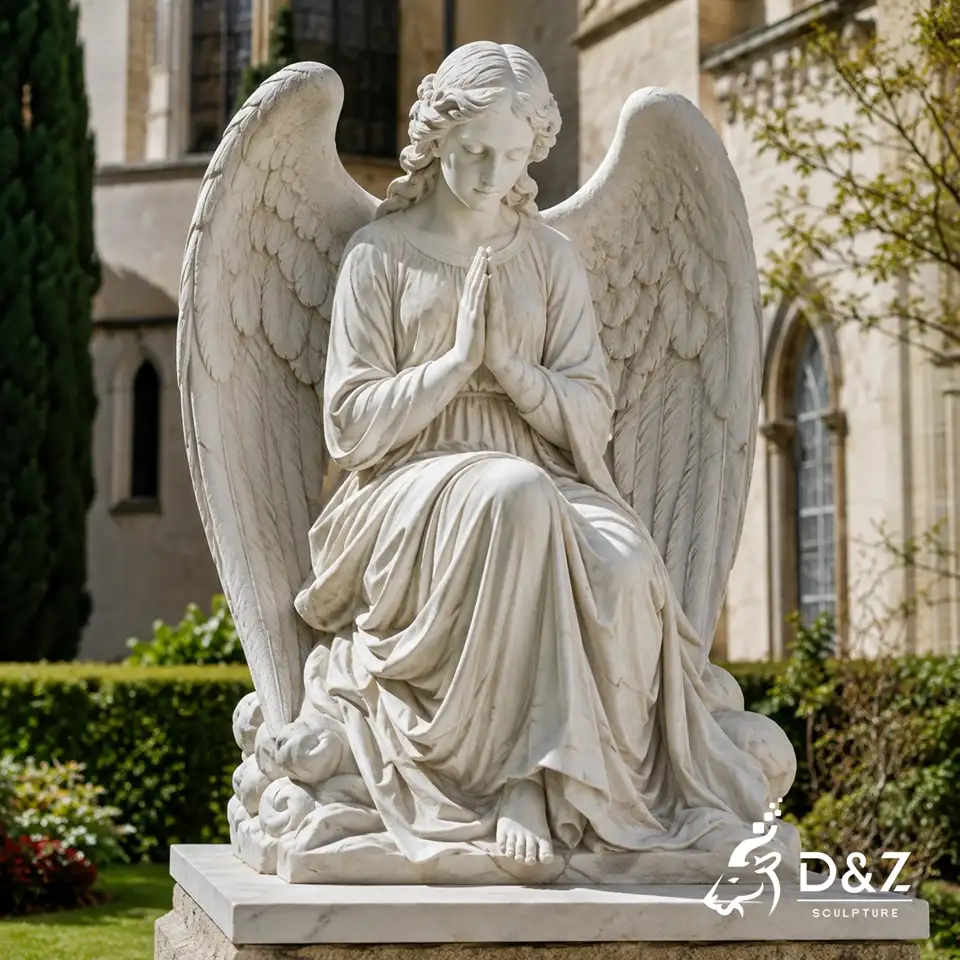
A praying or contemplative angel can represent belief, devotion, and a relationship with the spiritual world.
Folded hands, lowered eyes, and restrained posture are especially effective when an angel statue is intended for a church, chapel, memorial garden, or other reflective space.
Hope
Upward movement frequently changes the emotional tone of an angel.
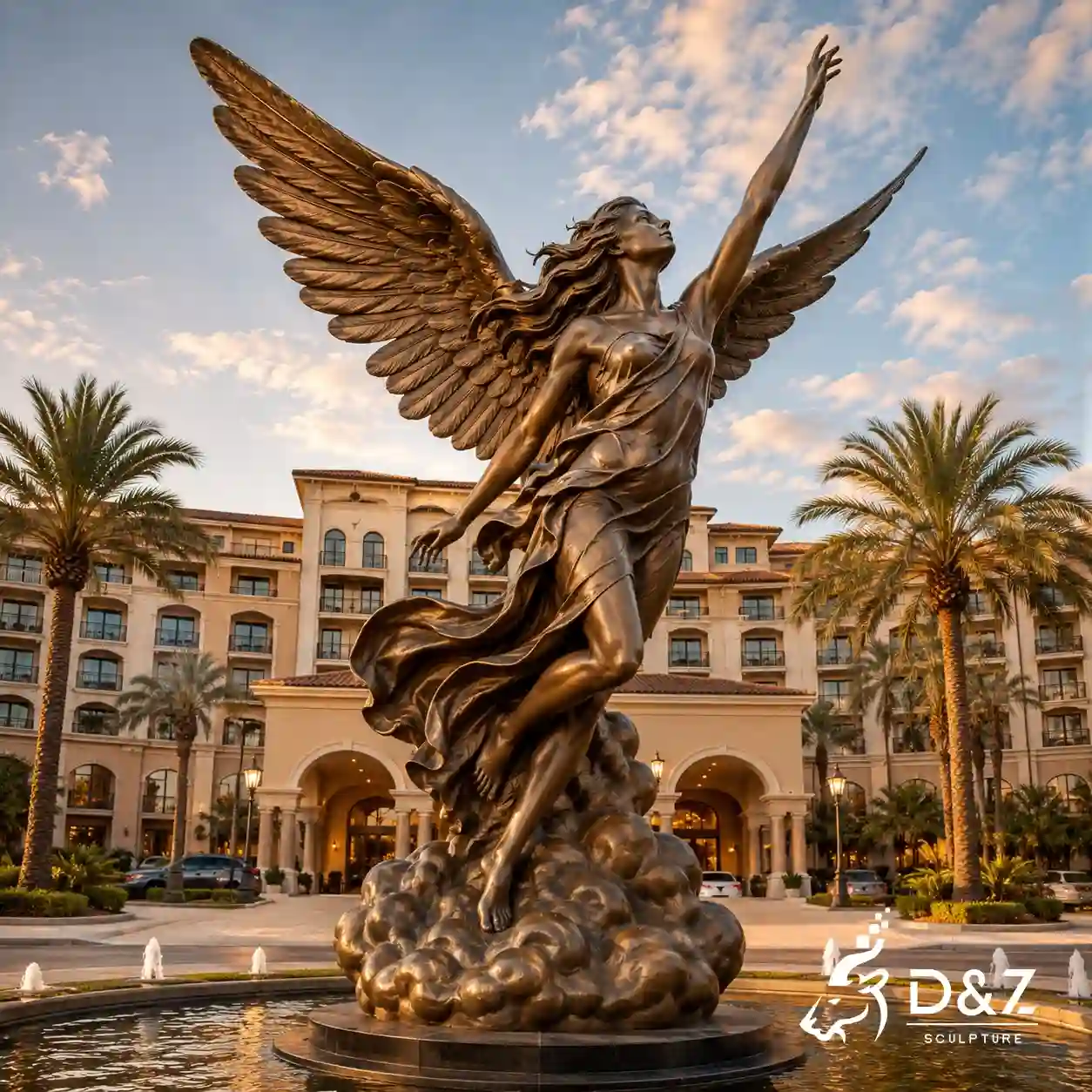
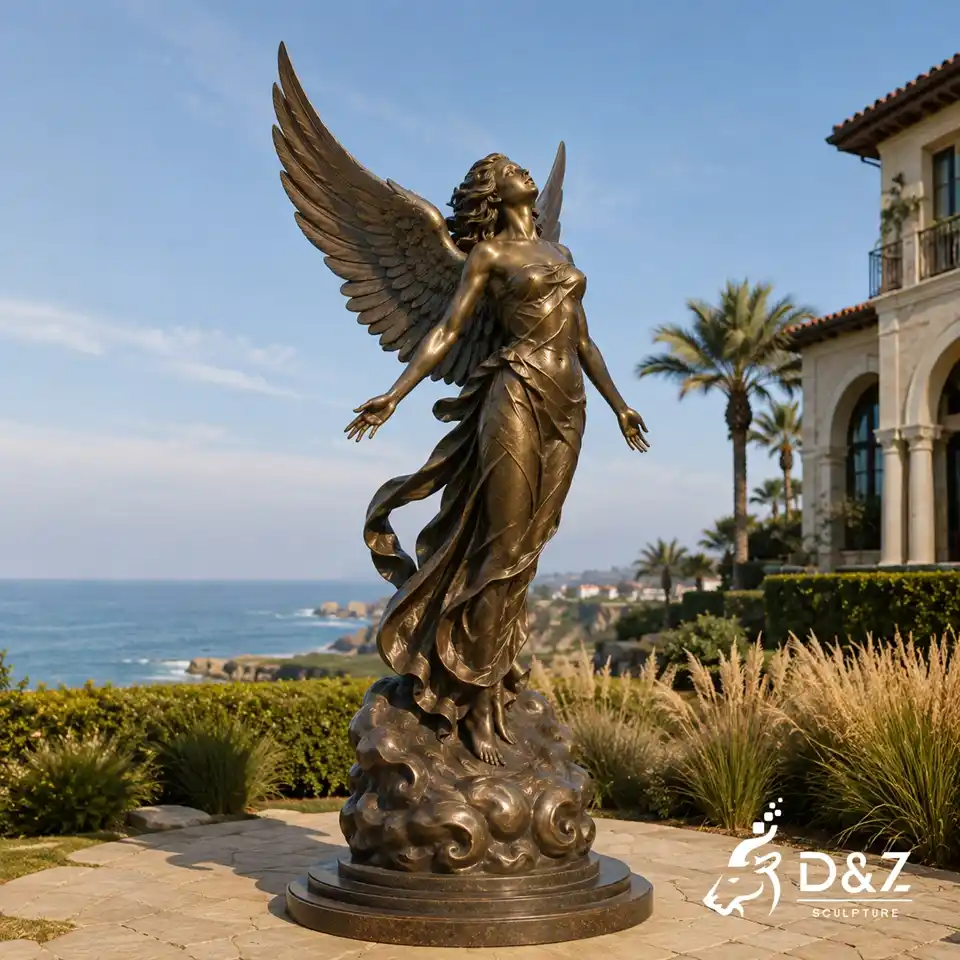
Raised wings, an upward gaze, or a body in flight can suggest a movement beyond present circumstances. For this reason, flying angels often symbolize hope, renewal, aspiration, freedom, and spiritual ascent.
Peace
Closed eyes, relaxed poses, softly folded wings, and calm expressions create a different emotional response.
These angels communicate stillness rather than movement and can symbolize peace, rest, serenity, and comfort.
Remembrance
In memorial and cemetery art, angels often become symbols of memory.
A cemetery angel sculpture may communicate grief, but it can also express continued love, respect, comfort, and the idea that someone is remembered beyond death.
Guidance
Because angels have traditionally been understood as messengers and guardians, they can also symbolize direction.
An extended hand, forward movement, or watchful pose can suggest guidance, encouragement, spiritual direction, and companionship.
4. Angel Sculpture Meaning in Famous Works Around the World
Looking at a famous angel sculpture can help you understand how artists use posture, material, setting, and historical context to create meaning.
The Angel of Grief — Rome, Italy
William Wetmore Story created The Angel of Grief in 1894 as a memorial for his wife at Rome’s Non-Catholic Cemetery. The angel collapses over the tomb with its head lowered and wings falling around the body. Rather than presenting an angel as powerful or triumphant, the sculpture turns grief itself into a physical posture. It has consequently become a powerful image of mourning, love, loss, and remembrance.
The Fallen Angel — Madrid, Spain
Ricardo Bellver’s El Ángel Caído depicts Lucifer at the moment of his fall from Paradise. Created in the late 1870s and later installed in Madrid’s Retiro Park, its twisting body and dramatic expression communicate conflict and suffering rather than peace. Within the broader language of angel sculpture, it demonstrates how pose can transform angel imagery into a symbol of fall, rebellion, lost grace, struggle, and consequence.
Angel of the Waters — New York, USA
Emma Stebbins’ Angel of the Waters crowns Bethesda Fountain in Central Park. Dedicated in 1873, the sculpture was inspired by the biblical Pool of Bethesda and the story of an angel associated with healing waters. Its raised wings, gentle movement, and relationship with flowing water make healing, blessing, hope, and peace central to its meaning.
Winged Victory / Angel of Victory — Canada
The Canadian Pacific Railway commissioned three Winged Victory memorials by Coeur de Lion MacCarthy for Vancouver, Winnipeg, and Montreal after the First World War. The composition depicts an angel carrying a deceased soldier toward heaven and originally includes the victorious symbolism of a laurel wreath. The work combines sacrifice, remembrance, loss, freedom, victory, and hope beyond death.
Angel of Independence — Mexico City, Mexico
Mexico City’s famous El Ángel is commonly called an angel, but the figure at the top of the Independence Monument is actually a Winged Victory inspired by the Greek goddess Nike. Holding a laurel wreath and broken chain, the figure symbolizes victory, freedom, independence, and national identity. It is an important reminder that not every winged human figure in public sculpture represents a religious angel.
Winged Victory of Samothrace — Louvre, Paris, France
The Winged Victory of Samothrace is also not an angel. It represents Nike, the ancient Greek goddess of victory, shown dramatically alighting on the prow of a ship. Dating to the Hellenistic period, its powerful wings and wind-driven drapery communicate victory, movement, triumph, and divine presence. Images such as Nike also helped establish a visual tradition in which wings communicate supernatural movement and power—a language later familiar in angel art.
The Angel of the North — Gateshead, England
Antony Gormley’s Angel of the North, installed in 1998, replaces traditional feathered wings with monumental industrial forms. Gormley described his intention as creating a focus of hope during a difficult transition in northeast England from an industrial to an information-based society. Here, angel sculpture meaning expands beyond religion into hope, transition, collective memory, place, and community identity.
5. Angel Sculpture Meaning by Pose, Wings, and Expression
The same basic angel figure can communicate very different emotions simply by changing its body language.
Flying Angel Sculpture
A flying angel usually communicates movement upward or forward.
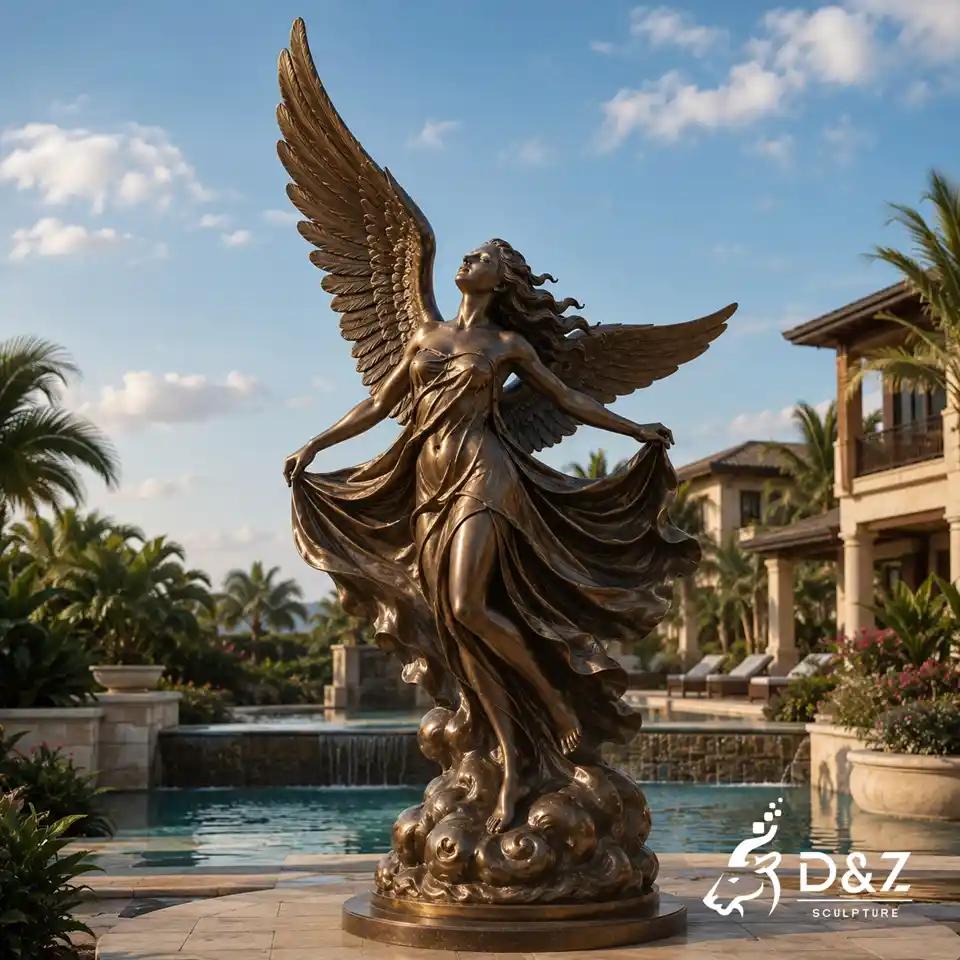
Spread wings, lifted arms, wind-blown robes, and an upward gaze can symbolize hope, freedom, spiritual ascent, inspiration, and guidance.
Sleeping Angel Sculpture
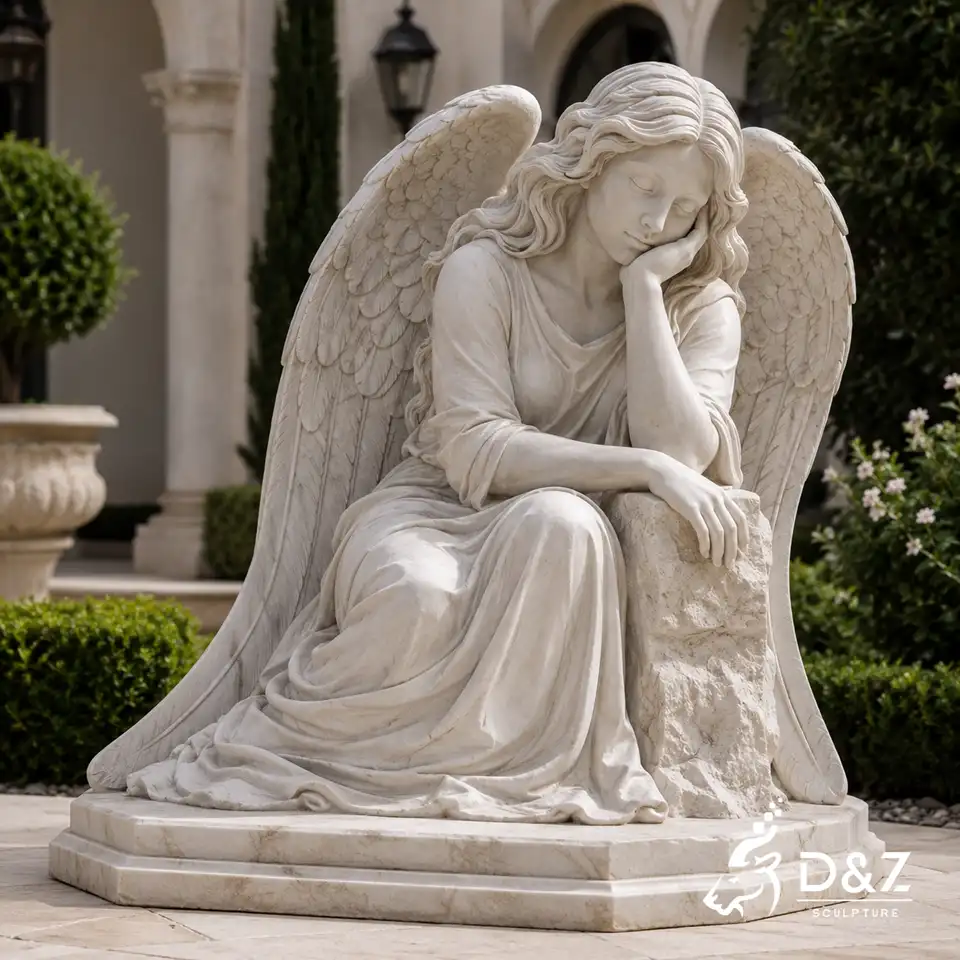
Closed eyes and a relaxed body create stillness.
A sleeping angel often represents peace, eternal rest, remembrance, reflection, and comfort, making this form especially suitable for memorial gardens and cemetery landscapes.
Praying Angel Sculpture
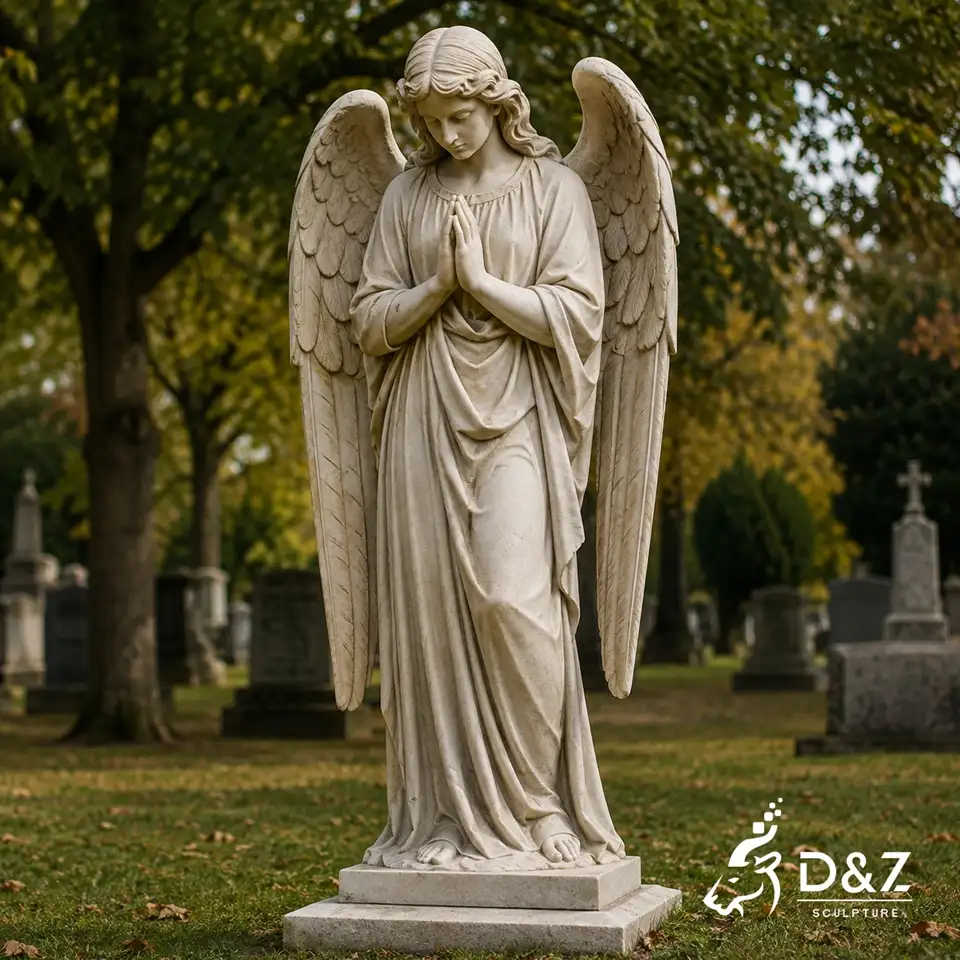
Folded hands, lowered eyes, and a calm posture immediately suggest contemplation.
A praying angel commonly represents faith, devotion, blessing, gratitude, hope, and spiritual protection.
Weeping Angel Sculpture
A bowed head, covered face, lowered wings, or collapsed posture communicates grief.
The meaning of this angel sculpture is usually connected with mourning, sorrow, remembrance, compassion, and enduring love.
Guardian or Standing Angel Sculpture
An upright angel with open or protective wings creates a sense of presence and watchfulness.
This form often represents protection, strength, guidance, reassurance, and guardianship.
The wings themselves also influence interpretation. Wide-open wings feel active and powerful; folded wings feel quiet and contemplative. An upward gaze tends to suggest hope, while closed eyes suggest prayer, peace, sleep, or reflection.
6. Angel Sculpture Meaning in Three New D&Z Designs
At D&Z Sculpture, we recently developed three angel designs that express three different emotional directions: hope, peace, and faith.
Flying Angel Sculpture — Hope and Freedom
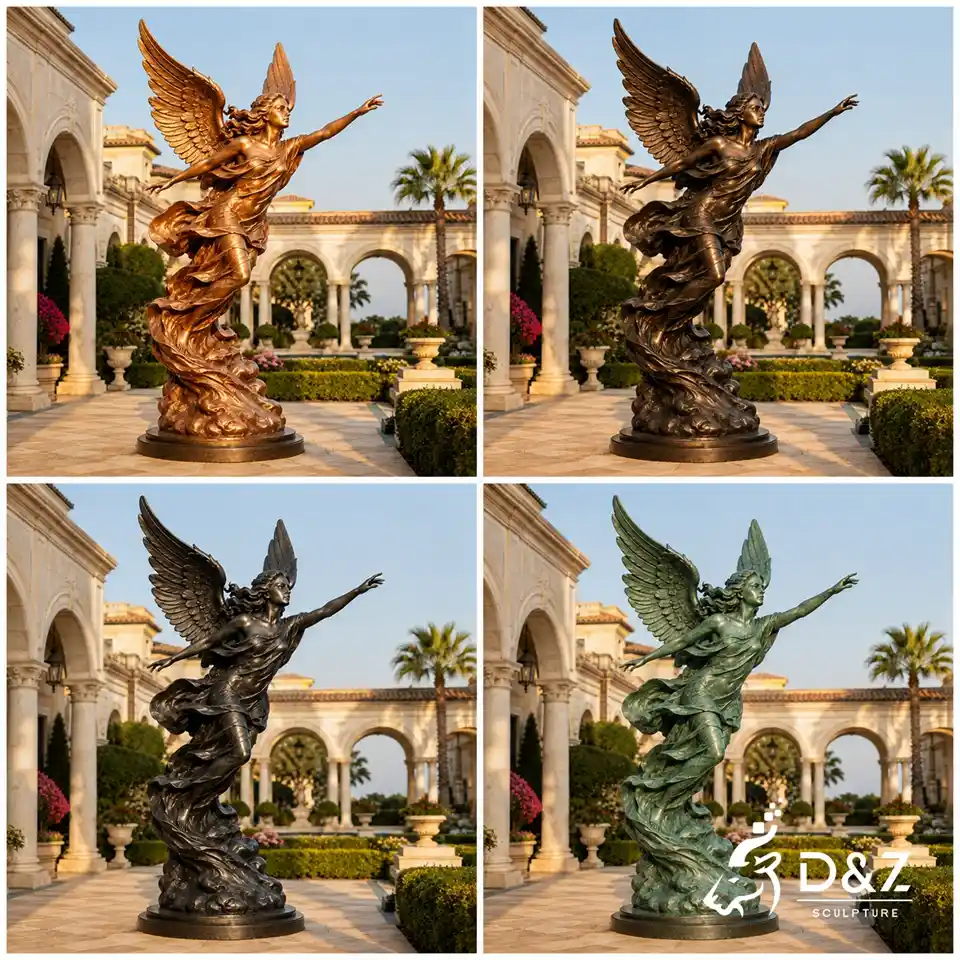
- Design: The DZC82 bronze flying angel uses fully spread wings, an upward-forward body position, flowing hair, and wind-swept robes to create a strong sense of motion.
- Meaning: Hope, freedom, inspiration, guidance, and spiritual ascent.
- Why choose it: Choose a flying angel when you want the artwork to feel uplifting, energetic, and aspirational rather than quiet or solemn.
- Common locations: Public plazas, hotel entrances, resorts, estates, parks, landscape projects, church courtyards, and memorial spaces.
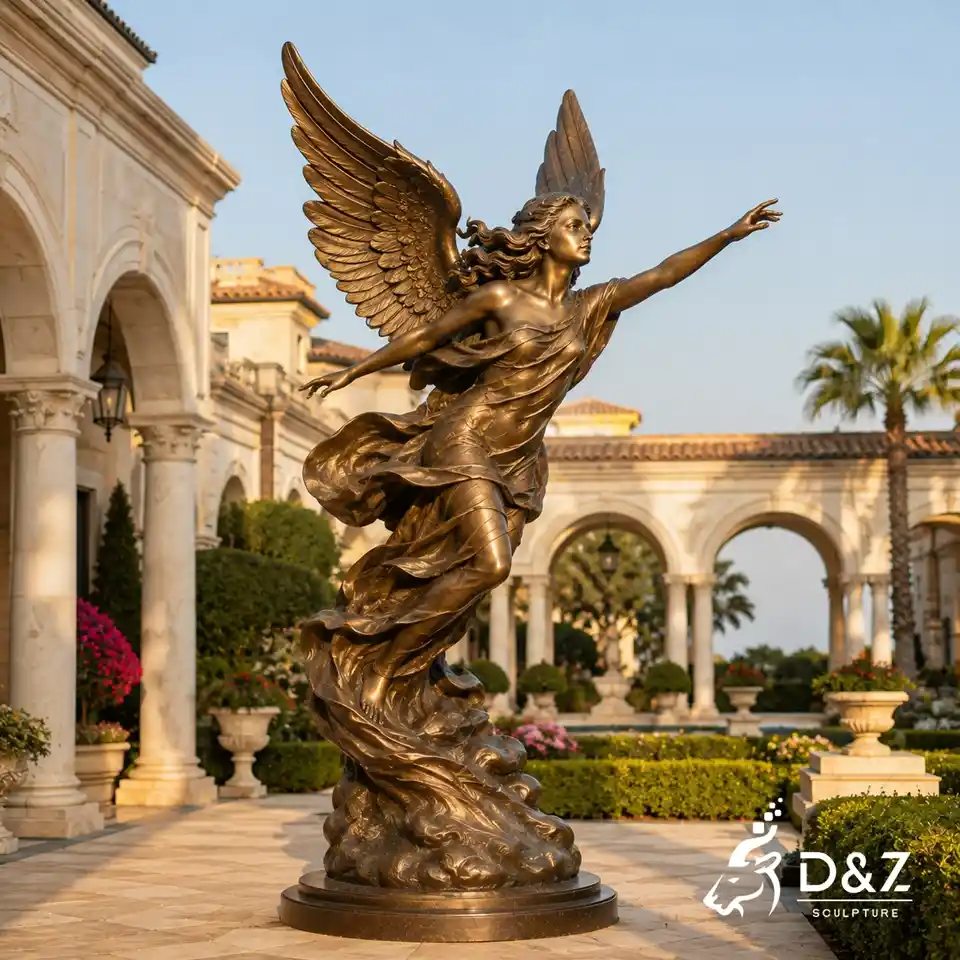
Explore the Large Bronze Flying Angel Sculpture with Spread Wings DZC82
Sleeping Angel Sculpture — Peace and Remembrance
- Design: DZC83 is carved from natural marble and shows an angel resting peacefully with closed eyes, a relaxed expression, detailed wings, and a classical pedestal.
- Meaning: Peace, remembrance, eternal rest, comfort, and quiet reflection.
- Why choose it: A sleeping angel is appropriate when the purpose of the artwork is to create stillness or preserve a memory rather than express movement.
- Common locations: Memorial gardens, cemeteries, churches, private gardens, courtyards, estates, and remembrance spaces.
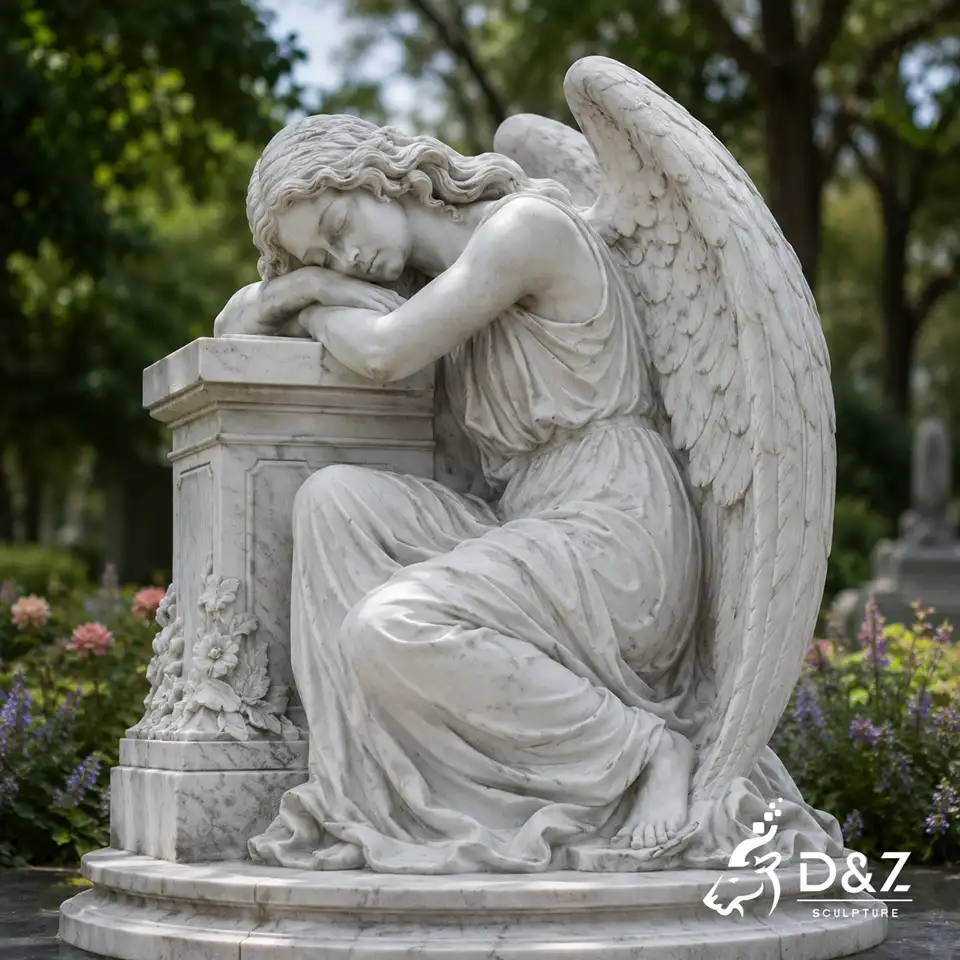
Explore the Large Marble Sleeping Angel Sculpture | Custom Memorial Garden Statue DZC83
Praying Angel Garden Sculpture — Faith and Blessing
- Design: DZC84 features folded prayer hands, lowered eyes, resting wings, flowing robes, and a restrained marble composition.
- Meaning: Faith, prayer, blessing, devotion, peace, and protection.
- Why choose it: A praying angel works well when the message is spiritual, reflective, grateful, or commemorative.
- Common locations: Gardens, church grounds, courtyards, cemeteries, memorial spaces, villas, and landscaped outdoor environments.
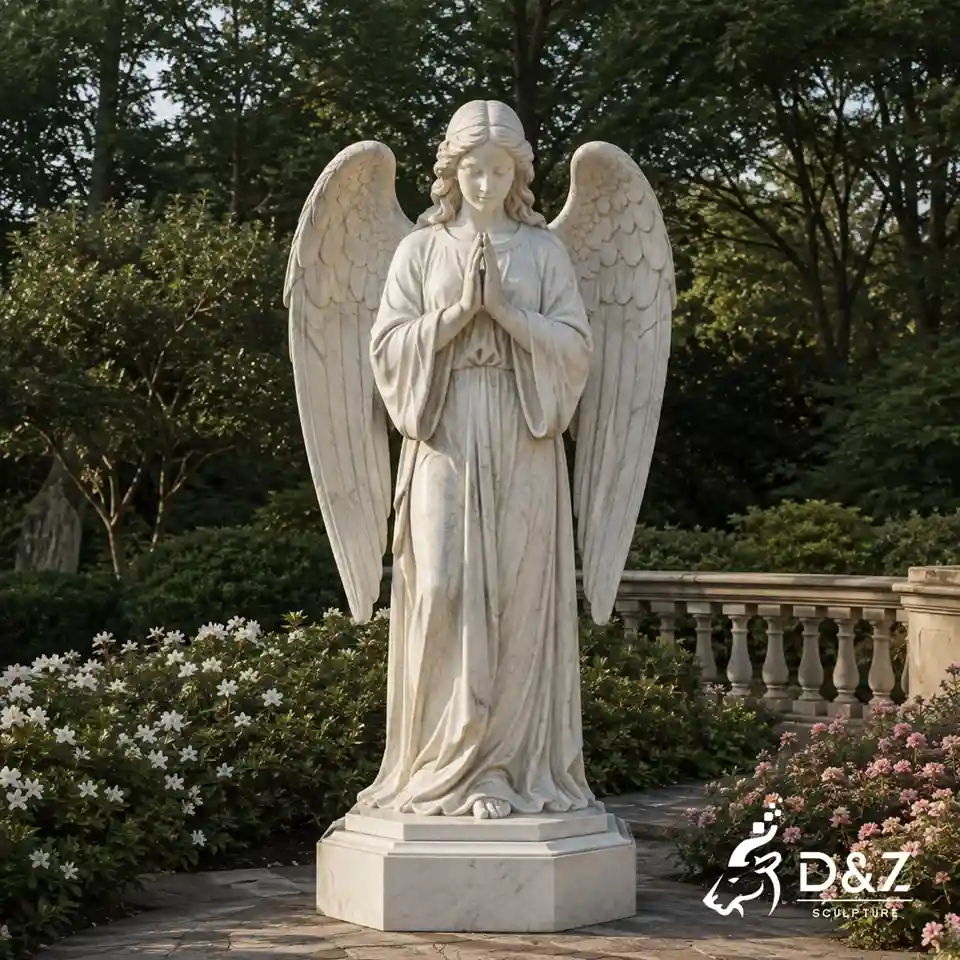
Explore the Hand-Carved Marble Praying Angel Garden Sculpture DZC84
7. How to Choose an Angel Sculpture by Meaning
Choosing an angel sculpture should begin with meaning rather than material, size, or decoration.
Perhaps you could consider three questions.
Choose by Space
The surrounding environment already establishes part of the emotional context.
- For a memorial angel sculpture, sleeping, praying, kneeling, or weeping angels can express remembrance, dignity, peace, or comfort.
- For a cemetery angel sculpture, resting angels, guardian angels, praying angels, and angels with folded wings can create a quiet commemorative atmosphere.
- For a church angel sculpture, praying, standing, guardian, or archangel-inspired figures can reinforce faith, devotion, blessing, and protection.
- For an angel garden sculpture, the choice is broader. A sleeping angel can make a garden contemplative; a praying angel can make it spiritual; a standing guardian angel can suggest protection; and a flying angel can make the landscape feel uplifting and dynamic.
- For hotels, resorts, parks, plazas, and large commercial landscapes, a monumental outdoor angel sculpture can function less as religious decoration and more as a landmark expressing hope, welcome, beauty, freedom, or identity.
Choose by Emotion
You could ask yourself:
How do I want to feel when I see this sculpture?
- If the answer is hope, consider a flying or upward-looking angel.
- If it is peace, consider a sleeping or resting angel.
- If it is faith or blessing, consider a praying angel.
- If it is protection, consider a guardian or standing winged angel.
- If it is remembrance, a sleeping, praying, kneeling, or weeping angel may be more appropriate.
A sculpture works best when its pose naturally produces the emotion you want people to experience.
Choose by Message
Then ask:
What do I want this sculpture to say to my family, visitors, guests, or community?
Perhaps the message is:
- “May this place remain peaceful.”
- “You will always be remembered.”
- “Hope continues.”
- “May you be protected.”
- “Faith gives us strength.”
- “Freedom is worth remembering.”
Once the message is clear, the appropriate angel form becomes much easier to choose.
8. How Material Influences Angel Sculpture Meaning
Material usually does not change the fundamental angel sculpture meaning.
For example, a praying angel remains associated with prayer whether carved from marble or cast in bronze.
What material changes is how that meaning feels visually.
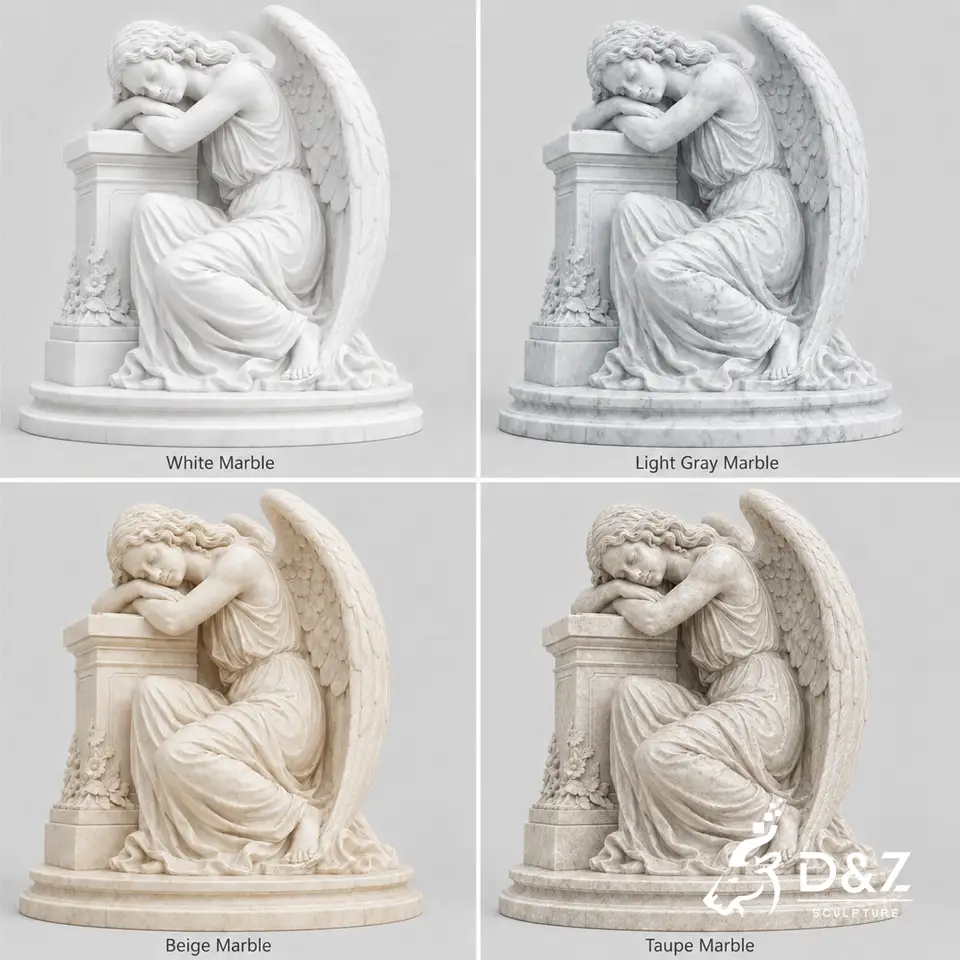
Marble Angel Sculpture
Marble creates a quiet, classical, and timeless visual language.
Light-colored stone can reinforce associations with purity, serenity, peace, permanence, and eternity. The smooth transition between skin, robes, hair, and wings also suits calm and contemplative figures.
For this reason, marble works particularly well for sleeping angels, praying angels, memorial angels, cemetery sculptures, garden figures, and classical architectural spaces.
Bronze Angel Sculpture
Bronze creates a heavier and more monumental visual presence.
Its metal surface, depth of color, structural strength, and ability to support complex forms can reinforce ideas of dignity, strength, endurance, permanence, and public significance.
Bronze is especially effective for flying angels, large winged figures, guardian angels, monuments, and large outdoor angel sculpture projects.
The difference is therefore not necessarily:
Marble = one meaning / Bronze = another meaning.
It is better understood as:
the same symbolic idea expressed through a different visual personality.
9. FAQs About Angel Sculpture Meaning
Q: What does an angel sculpture symbolize?
A: It commonly represents protection, faith, hope, peace, remembrance, guidance, or blessing.
Q: What does a guardian angel statue mean?
A: It usually symbolizes protection, guidance, reassurance, and watchfulness.
Q: What does a kneeling angel sculpture mean?
A: It often represents humility, devotion, prayer, reflection, or mourning.
Q: What does a weeping angel statue symbolize?
A: It commonly expresses grief, remembrance, compassion, mourning, and enduring love.
Q: What does an angel with open wings symbolize?
A: Open wings often represent freedom, protection, spiritual power, hope, or ascension.
Q: What does an angel with folded wings mean?
A: Folded wings usually suggest peace, rest, contemplation, humility, or remembrance.
Q: Is it good to keep an angel statue at home?
A: Yes. It can represent protection, peace, faith, blessing, or hope, depending on the design you choose.
Q: What is the most famous angel statue in the world?
A: There is no single official answer. The Angel of Grief, Angel of the Waters, and Angel of the North are among the best-known examples.
Q: What is the best angel statue to keep at home?
A: Choose according to the feeling you want: guardian figures for protection, praying figures for faith, and sleeping figures for peace.
Q: Can angel statues be used without religious meaning?
A: Yes. They can also represent hope, freedom, remembrance, peace, protection, or personal meaning.
Q: Where can I find high-quality angel statues online?
A: Choose D&Z Sculpture as your supplier, and we can provide clear materials, customization, production, shipping, and installation support.
Q: What are popular angel statue designs for home or garden decor?
A: Popular choices include guardian, praying, sleeping, kneeling, winged, cherub, and memorial designs.
10. Why Angel Sculpture Meaning Endures Across Generations
Why have angel sculptures remained meaningful for so long? It is easy to say that the answer is their wings. But wings alone do not explain their lasting appeal.
What gives an angel sculpture significance is the emotion people attach to the figure.
- A lowered head can turn stone into grief.
- Closed eyes can create a feeling of peace.
- Hands joined in prayer can express faith and gratitude.
- A body rising into the air can make heavy bronze appear to represent freedom.
- Open wings can communicate protection without saying a word.
This is why angel sculptures continue to appear in churches, cemeteries, memorials, gardens, private homes, hotels, parks, and public landscapes. The visual form has changed across centuries, but the human need to express hope, memory, protection, faith, loss, and peace has not.
For a custom project, the most important question should therefore not be simply:
“What kind of angel do I want?”It should be:
“What do I want this angel to make people feel?”Every custom angel sculpture should begin with that question. Pose, facial expression, wings, gesture, scale, material, and location should then work together to communicate the intended emotion.
Whether you are drawn to the quiet permanence of a marble angel or the monumental dignity of a bronze angel, the right sculpture is ultimately the one whose meaning connects with the people who experience it.
At D&Z Sculpture, we develop custom angel sculptures around the meaning, emotion, architectural environment, and project requirements of each commission. From design development and material selection to fabrication, transportation, and installation support, our goal is not simply to manufacture an angel figure—it is to help create an artwork that says what you want it to say.