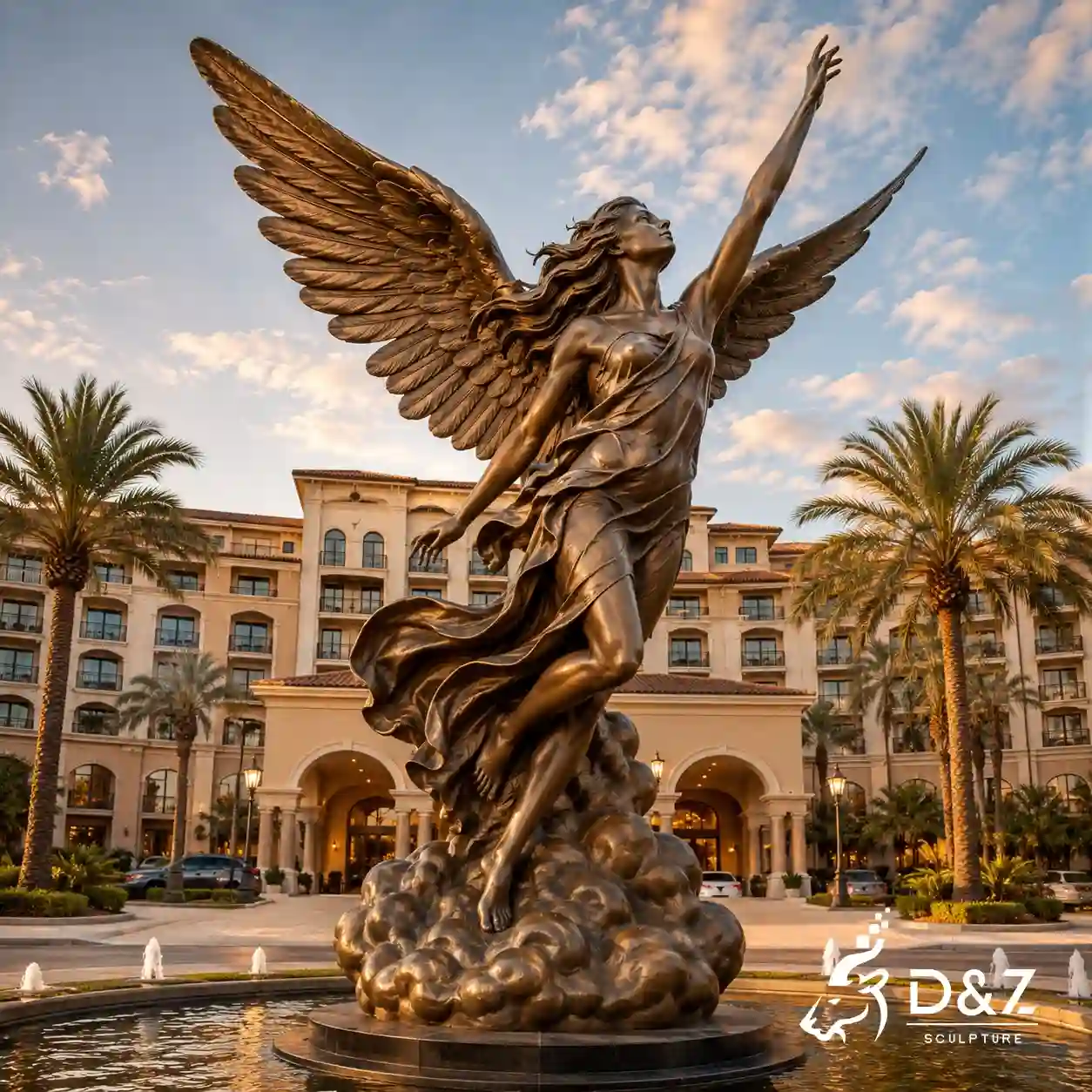
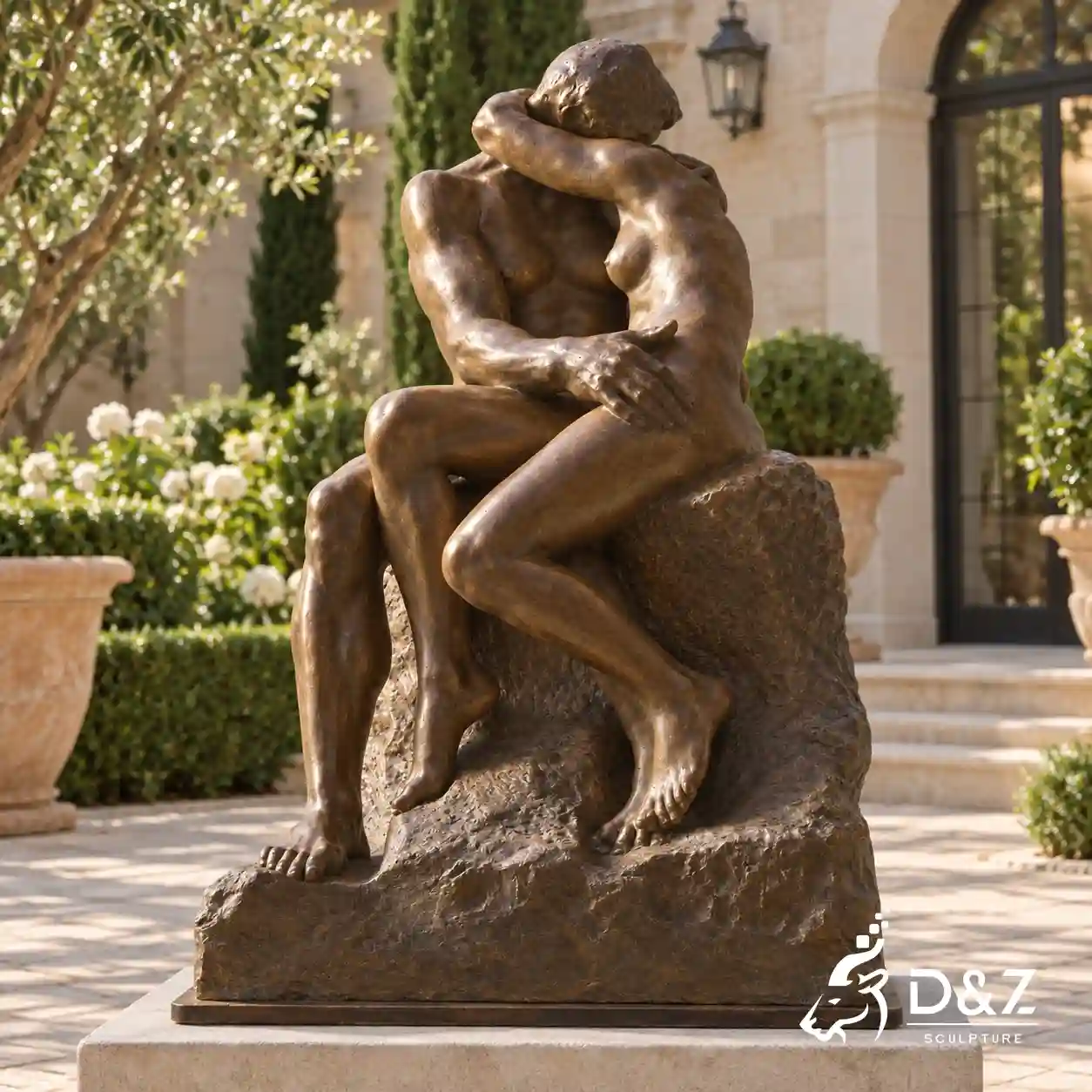
The Kiss Sculpture by Auguste Rodin is one of the most recognizable representations of love and intimacy in Western sculpture. Conceived around 1882, it was inspired by the tragic story of Paolo and Francesca from Dante’s Inferno, yet Rodin transformed their forbidden relationship into a timeless image of passion, desire, and human connection.
With intertwined bodies, naturalistic forms, and a powerful sense of movement, the sculpture combines romance with an underlying sense of tragedy.
This article explores the story, meaning, artistic style, composition, and lasting legacy of The Kiss sculpture, as well as the materials and design ideas behind modern kiss sculptures.
Table of Contents
What Is The Kiss Sculpture?
The Kiss sculpture is a famous work conceived by French sculptor Auguste Rodin around 1882.
The figures represent Paolo and Francesca, two lovers from Dante Alighieri’s Divine Comedy. They were originally created in connection with Rodin’s monumental The Gates of Hell but were removed from the composition in 1886 because their sensual happiness conflicted with the darker theme of the Gates. Rodin then developed the group as an independent sculpture and exhibited it in 1887.
Originally associated with the title Francesca da Rimini, the work gradually became known simply as The Kiss. With few historical details identifying the figures, the sculpture evolved from a specific literary scene into a universal symbol of romantic love.
The famous Paris the kiss marble sculpture was commissioned by the French state in 1888 and carved in Carrara marble between 1888 and 1898. It measures approximately 181.5 cm high.
The Story and Creation of The Kiss Sculpture
The story behind the kiss sculpture by Auguste Rodin comes from Dante’s Inferno.
Paolo and Francesca
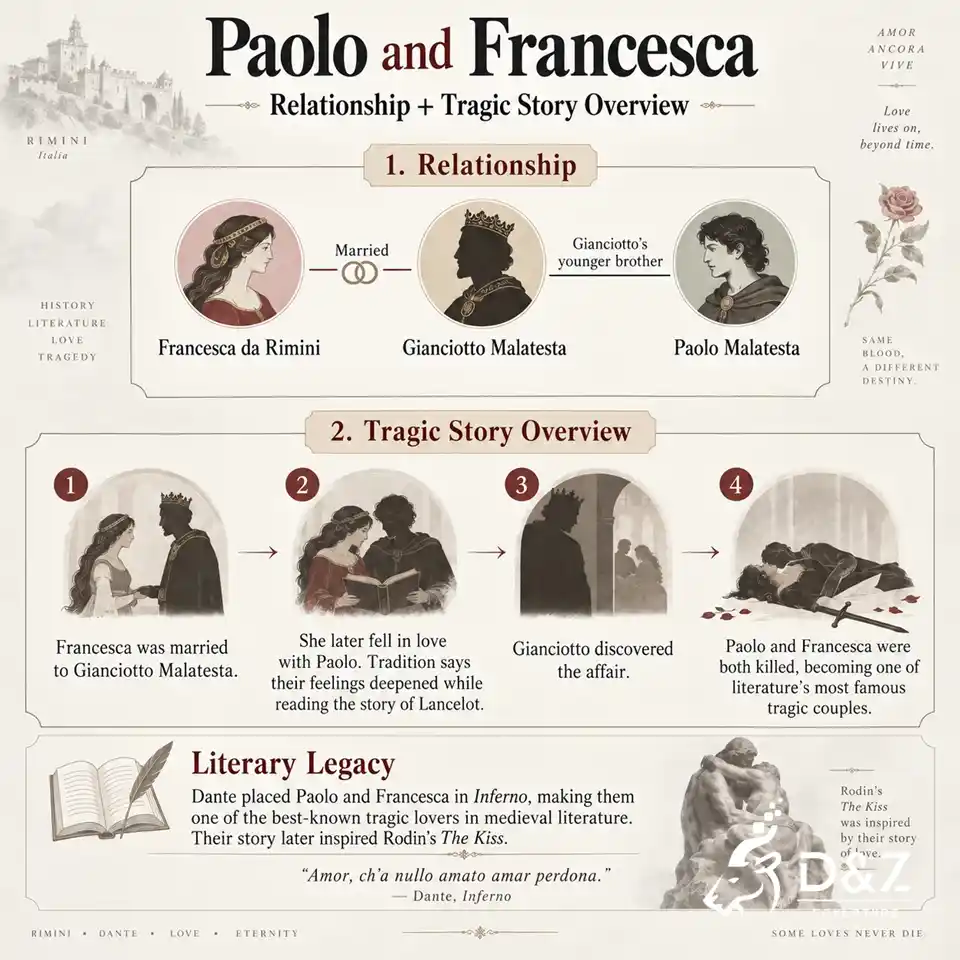
Francesca da Rimini was married to Gianciotto Malatesta. Paolo was Gianciotto’s younger brother, making him Francesca’s brother-in-law.
According to Dante’s story, Paolo and Francesca fell in love while reading the romance of Lancelot and Guinevere together. Their forbidden relationship was later discovered by Francesca’s husband, who killed them both.
Rodin did not choose to sculpt their murder or their suffering in Hell.
Instead, he focused on their moment of intimacy.
This decision shifts the emotional center of the story. Rather than showing punishment, rodin the kiss sculpture captures attraction, closeness, and desire before the tragic consequences arrive.
From The Gates of Hell to an Independent Sculpture
The lovers were originally placed as part of a group of reliefs of The Gates of Hell.
However, Rodin eventually decided that their happiness and sensuality did not fit the surrounding scenes of suffering and damnation. He removed them and later replaced them with another couple that better suited the theme of Hell.
Once separated from the Gates, the couple gained a completely different meaning.
Their medieval clothing, historical setting, and most obvious narrative clues disappeared. Viewers no longer needed to see them only as Paolo and Francesca.
They could simply see two lovers.
That transformation is one of the most important reasons the kiss sculpture by Rodin became so widely recognized.
From Model to Monumental Marble
The composition was conceived around 1882, but the famous monumental marble version was produced later.
The French government commissioned the marble in 1888. It was carved between 1888 and 1898, with practitioner Jean Turcan recorded in the Musée Rodin collection documentation.
This distinction is important when discussing the original The Kiss Rodin sculpture.
Rodin often worked first as a modeller in clay or plaster and relied on skilled practitioners to translate approved models into marble. The Musée Rodin describes Rodin primarily as a modeller and notes that working with practitioners was a normal part of his marble production.
Therefore, it is more accurate to say that the composition was conceived around 1882 and later developed through plaster, marble, and bronze versions rather than saying that the famous marble sculpture itself was completed in 1882.
What Does The Kiss Sculpture Mean?
The meaning of The Kiss sculpture is not limited to romance. Several ideas exist simultaneously within the same embrace.
Love and Passion
The most immediate meaning is romantic love.
The figures turn toward each other so completely that their individual bodies begin to form a single visual composition.
Rather than relying heavily on facial expression, Rodin communicates emotion through posture, touch, and physical proximity.
Desire and Sensuality
The sculpture is deeply sensual, but its sensuality comes from more than nudity.
The rotation of the torsos, overlapping limbs, placement of the hands, and closeness of the faces create the feeling that the viewer has interrupted an intimate moment.
The bodies appear to respond naturally to one another rather than posing formally.
Forbidden Love and Tragedy
Knowing the story of Paolo and Francesca changes how we read the sculpture.
Their attraction is genuine, but their relationship is forbidden and ultimately fatal.
The viewer therefore sees tenderness while already knowing its tragic outcome.
Love and tragedy occupy the same sculpture.
The Moment Before Consequence
Rodin does not show death.
He captures the lovers at the height of intimacy before the consequences of their relationship arrive.
Their faces draw extremely close, creating a suspended moment filled with expectation.
The tragedy remains outside the visible scene, which makes the peaceful embrace even more emotionally powerful.
The Kiss Sculpture Analysis: Composition, Form and Details
A closer analysis of The Kiss sculpture reveals why the composition remains powerful even without knowledge of Dante’s story.
1. Overall Composition
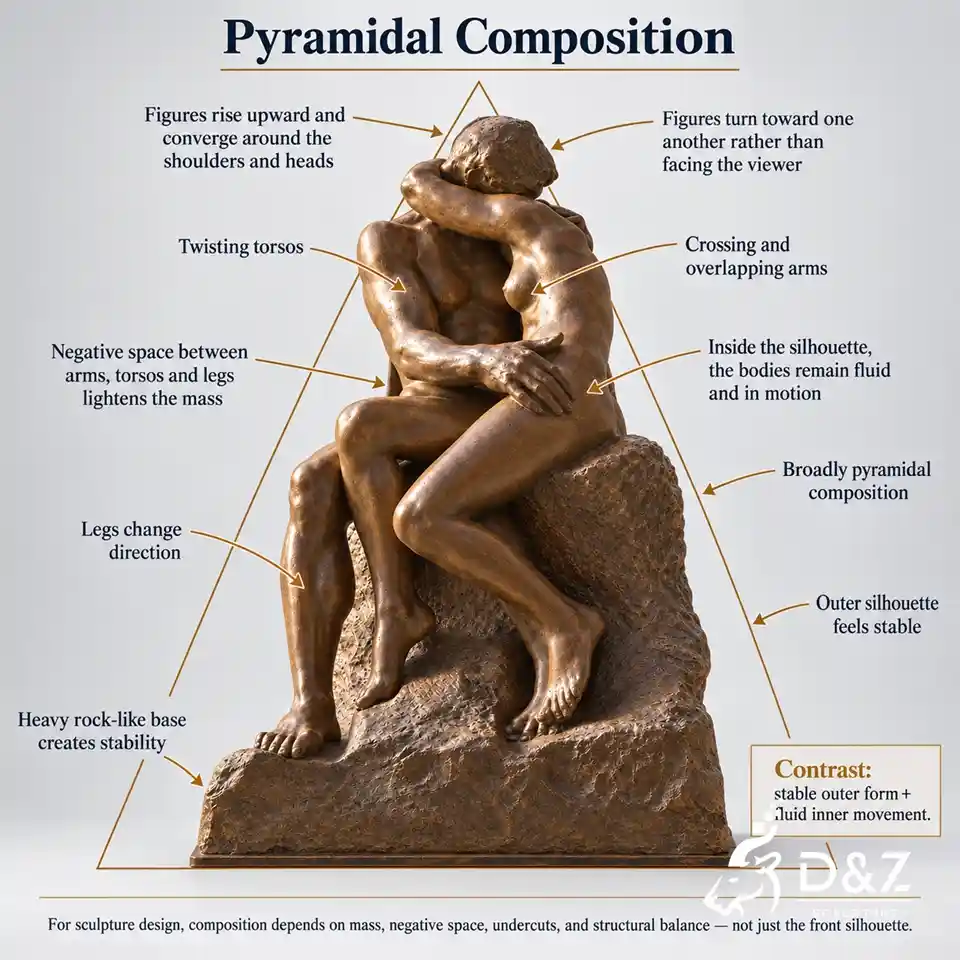
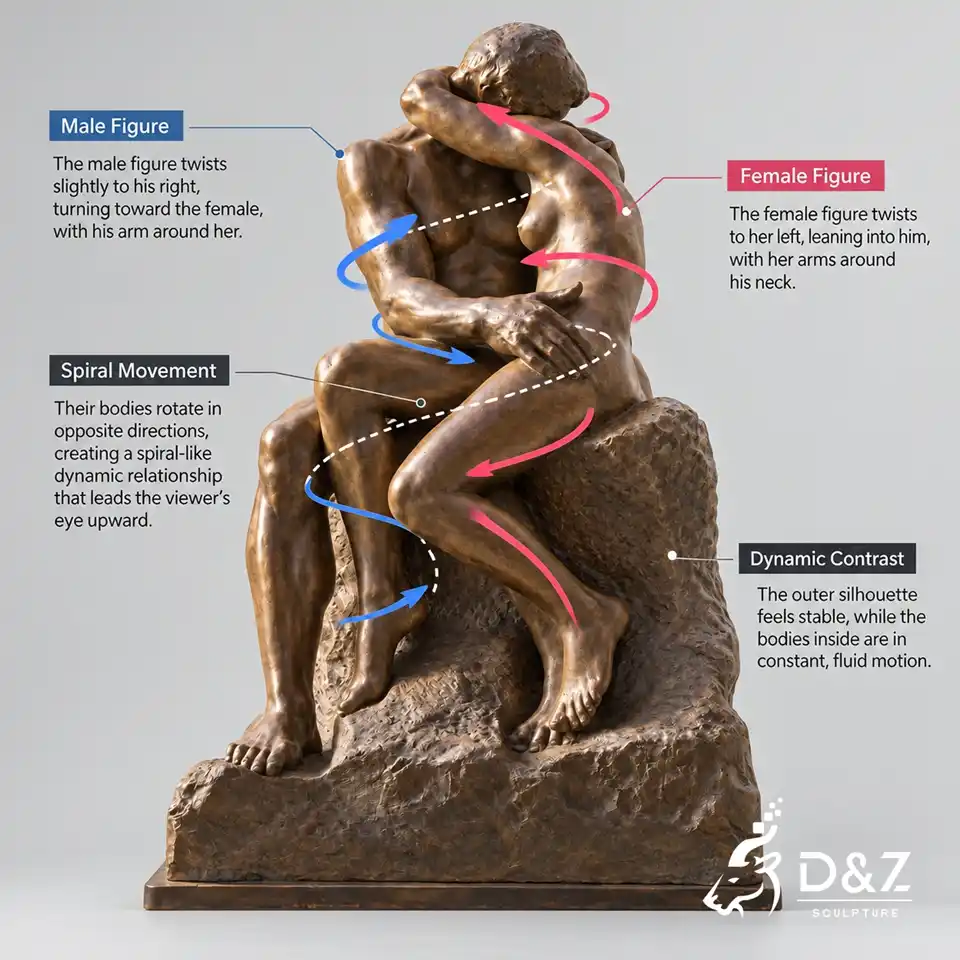
The sculpture uses a broadly pyramidal composition.
A heavy rock-like base creates stability at the bottom while the two figures rise upward and visually converge around the shoulders and heads. The Musée Rodin also describes the large model as having a relatively classical pyramidal structure.
Inside this stable outline, however, the bodies are constantly moving.
The torsos twist in different directions. Arms cross and overlap. Legs change direction. The figures turn toward one another rather than facing the viewer.
This creates an important contrast:
The outer silhouette feels stable, while the bodies inside it feel fluid.
Negative space also contributes to the composition. Openings between arms, torsos, and legs prevent the sculpture from becoming a single heavy block.
For a sculptor or manufacturer, this is particularly important. A successful sculpture of the kiss is not created by copying only the front silhouette. The relationship between mass, negative space, undercuts, and structural balance is equally important.
2. The Pose of Paolo and Francesca
Paolo and Francesca are not positioned directly face-to-face.
Their bodies rotate toward each other, producing an almost spiraling relationship that encourages viewers to observe the sculpture from different angles.
Paolo’s back appears comparatively upright and controlled, while Francesca moves toward him with greater openness. The Musée Rodin similarly notes the contrast between the man’s relatively rigid back and hesitant gesture and the woman’s more confident embrace.
This prevents the sculpture from feeling static.
The embrace appears to be developing in front of the viewer.
It also gives the relationship a feeling of mutual attraction rather than presenting one figure simply dominating the other.
3. The Book and the Almost-Kiss
One small detail helps preserve the literary story.
Paolo holds a book.
It refers to the story of Lancelot and Guinevere that Paolo and Francesca were reading when their own attraction developed. Tate likewise identifies the book in Paolo’s hand as a reference to this episode in Dante.
Most other historical details have disappeared.
That makes the book particularly important: it connects the sculpture to Dante without turning the work into a heavily illustrated narrative scene.
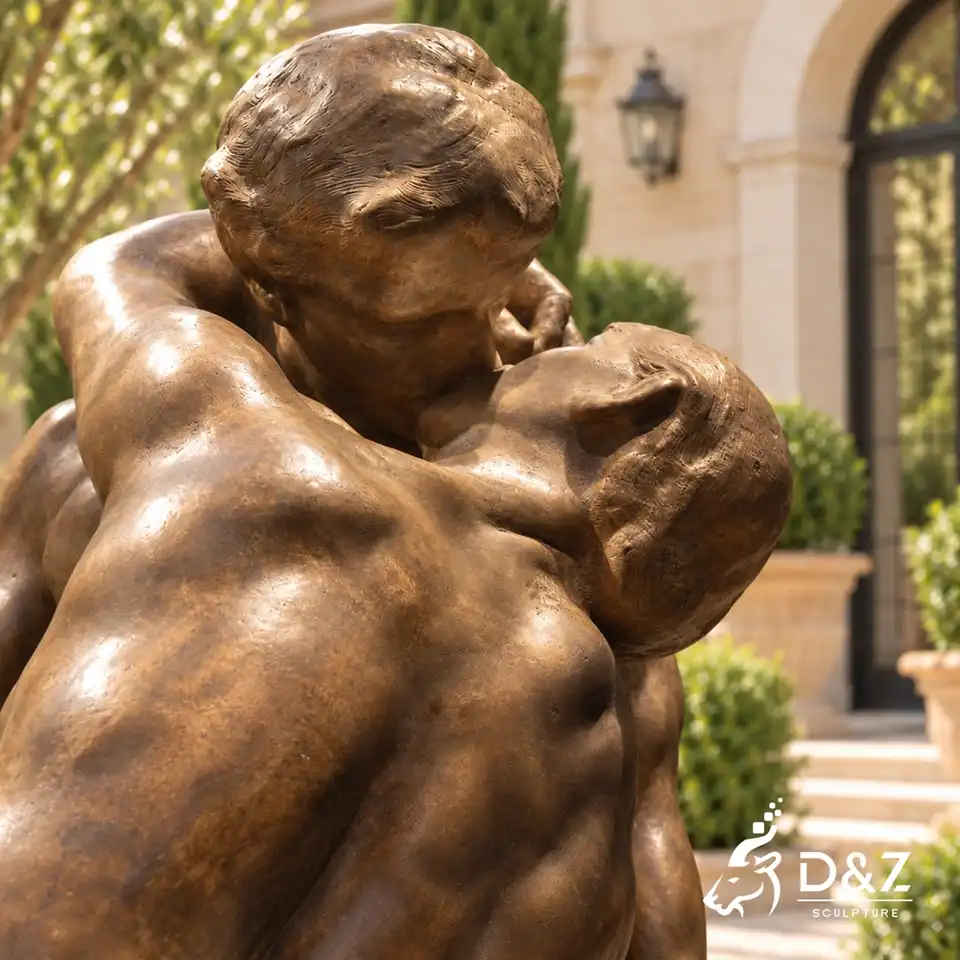
The faces provide another important visual detail.
The lovers appear extremely close to completing the kiss. Instead of exaggerating the gesture, Rodin creates tension through restraint.
The tiny remaining distance—or barely completed contact, depending on the version and viewing angle—creates anticipation.
The viewer feels the movement toward the kiss rather than simply seeing a finished pose.
4. Smooth Bodies and Rough Stone
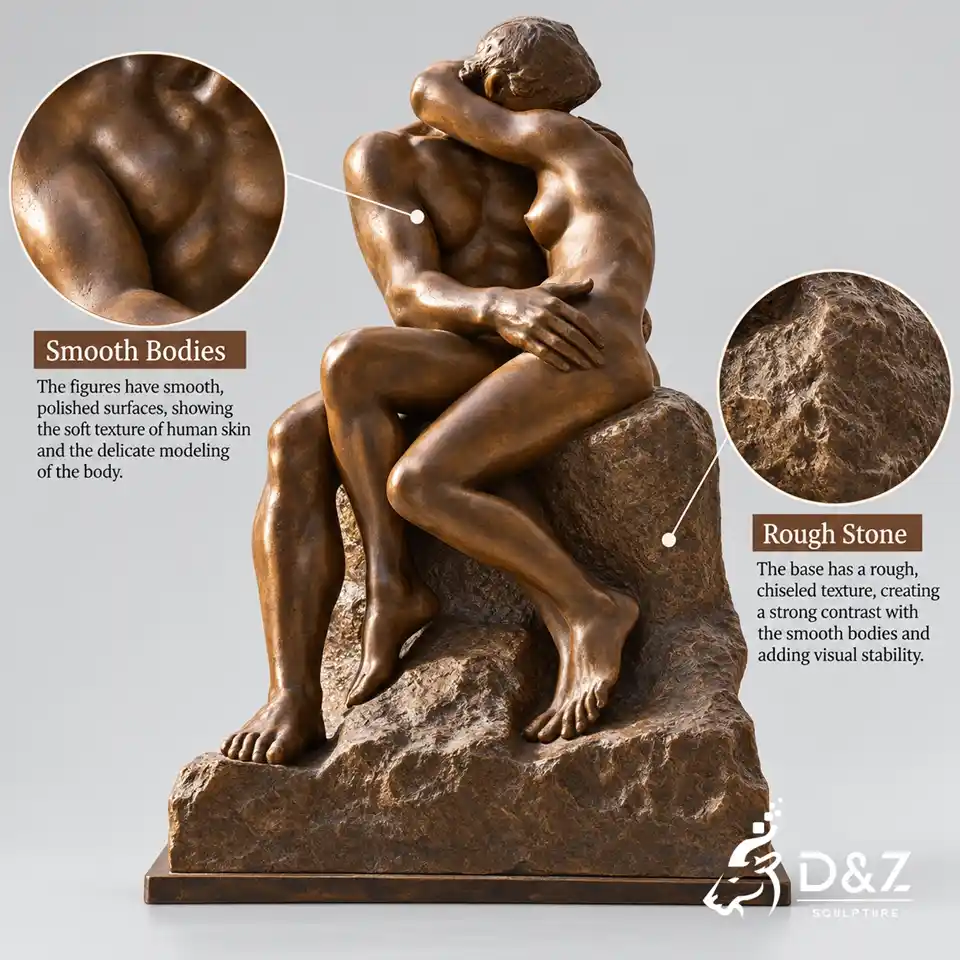
One of the most striking details of The Kiss sculpture is the contrast between the lovers’ highly polished bodies and the rough, unfinished-looking stone beneath them.
This reflects Rodin’s characteristic use of non-finito, or the “unfinished” aesthetic. The lovers’ skin, torsos, and limbs are carved and polished with remarkable smoothness, while the rocky base retains visible chisel marks and rough stone textures, as if parts of the sculpture were deliberately left incomplete.
This contrast can also be read in relation to the story of Paolo and Francesca.
Their love itself was never allowed to reach a natural conclusion. Rodin captures them at the moment of intimacy, just before tragedy interrupts their relationship. In this sense, the unfinished stone seems to echo the unfinished moment: the lovers are suspended between desire and consequence, while the sculpture itself appears to stop between refined form and raw marble.
The result is especially powerful—the bodies feel complete and alive, but the surrounding stone feels abruptly unfinished, visually reinforcing the sense that their love story was suddenly cut short.
5. Sensuality and Naturalism
The human bodies in the kiss sculpture Rodin feel convincing because they communicate weight and physical response.
Muscles follow the movement of the pose rather than appearing as decorative anatomy.
Francesca’s curves flow toward Paolo, while his back and torso provide structural strength within the composition.
Marble further intensifies this effect.
The Musée Rodin notes that marble has historically been valued for its ability to suggest human flesh: a hard and cold material can visually appear warm and supple after sculptural treatment.
In The Kiss, that transformation is central to the work.
Stone appears to become skin.
Why Is The Kiss Sculpture So Famous?
Many sculptures represent lovers, but relatively few have achieved the cultural recognition of The Kiss sculpture.
Several artistic choices help explain its lasting popularity.
A Specific Story Becomes Universal
Rodin began with Paolo and Francesca but removed most visual information tying them specifically to medieval Italy.
There are no elaborate costumes or architectural settings.
There is no representation of their murder.
Only the book quietly preserves the literary connection.
This allows viewers who know nothing about Dante to understand the sculpture immediately.
A medieval tragedy becomes a universal image of two people in love.
Love Is Shown as Mutual
The composition depends on both figures.
Both turn inward.
Both participate in the embrace.
Neither body makes visual sense without the other.
This reciprocity gives auguste Rodin kiss sculpture an emotional warmth that differs from many traditional compositions in which one figure dominates the narrative.
A Temporary Moment Becomes Permanent
A kiss normally lasts only moments.
Marble can survive for centuries.
Rodin brings these opposites together by giving a fleeting moment of intimacy physical permanence.
The lovers never move beyond this moment.
Their embrace remains permanently suspended.
Emotion Is Easy to Understand
A viewer does not need to understand nineteenth-century French art or medieval literature to recognize what is happening.
The sculpture communicates through the body.
Touch, closeness, hesitation, and desire are human experiences that cross cultural and historical boundaries.
That direct emotional accessibility is one of the strongest reasons The Kiss sculpture continues to attract audiences.
Where Can You See The Kiss Sculpture?
Three major monumental marble versions are especially associated with the history of The Kiss sculpture.
The French-state version is in the Musée Rodin in Paris; another important marble version from 1901–1904 belongs to Tate in the United Kingdom; and a third monumental marble version is held by the Ny Carlsberg Glyptotek in Copenhagen. The Musée Rodin notes that three marble versions produced after 1900 helped establish the work’s lasting fame.
Bronze casts and other versions of rodin sculpture the kiss can also be found in museum collections around the world.
For visitors specifically seeking the famous Paris marble, Musée Rodin currently lists it in its permanent collection, while noting that works may occasionally be away on loan.
The Legacy and Influence of The Kiss Sculpture
The artistic legacy of The Kiss sculpture extends far beyond copies of its exact pose.
Rodin demonstrated that human emotion could be expressed primarily through the physical relationship between bodies.
Rotation, weight, touch, surface, and negative space became part of the storytelling.
The work also demonstrates how a sculpture can escape its original narrative.
Paolo and Francesca began as characters from Dante and as figures within The Gates of Hell. Once separated from that project, the group became an independent symbol of love.
This process was characteristic of Rodin’s broader creative practice. He frequently reused, enlarged, separated, and recombined figures and fragments developed during his work on The Gates of Hell.
Modern kissing sculpture and kissing statue designs still draw on many of the principles visible in Rodin’s work:
intertwined silhouettes, rotational movement, tactile surfaces, intimate body language, and the use of two figures as one complete sculptural composition.
However, the most valuable lesson is not to copy Rodin’s exact pose.
It is to understand why the composition works.
At D&Z Sculpture, we see three especially useful principles in the work: the figures should form a unified visual mass, their gestures should communicate a believable emotional response, and the material and surface treatment should reinforce the subject.
These principles can inspire completely new kiss sculpture designs while preserving the emotional strength that made Rodin’s work famous.
Custom The Kiss Sculpture and Related Kiss Designs
D&Z Sculpture can create fully customized The Kiss sculpture designs based on your project needs.
The pose, kissing gesture, body movement, hand position, facial direction, clothing, base design, and overall composition can all be customized. Whether you prefer a standing couple, seated lovers, a more subtle embrace, or a more dramatic kissing pose, the sculpture can be developed around your specific concept and installation space.
For projects that prefer the classical appearance of Rodin’s masterpiece, we can also create a faithful reproduction of the original composition, carefully recreating its intertwined figures, embracing arms, tilted bodies, anatomical details, and rocky base.
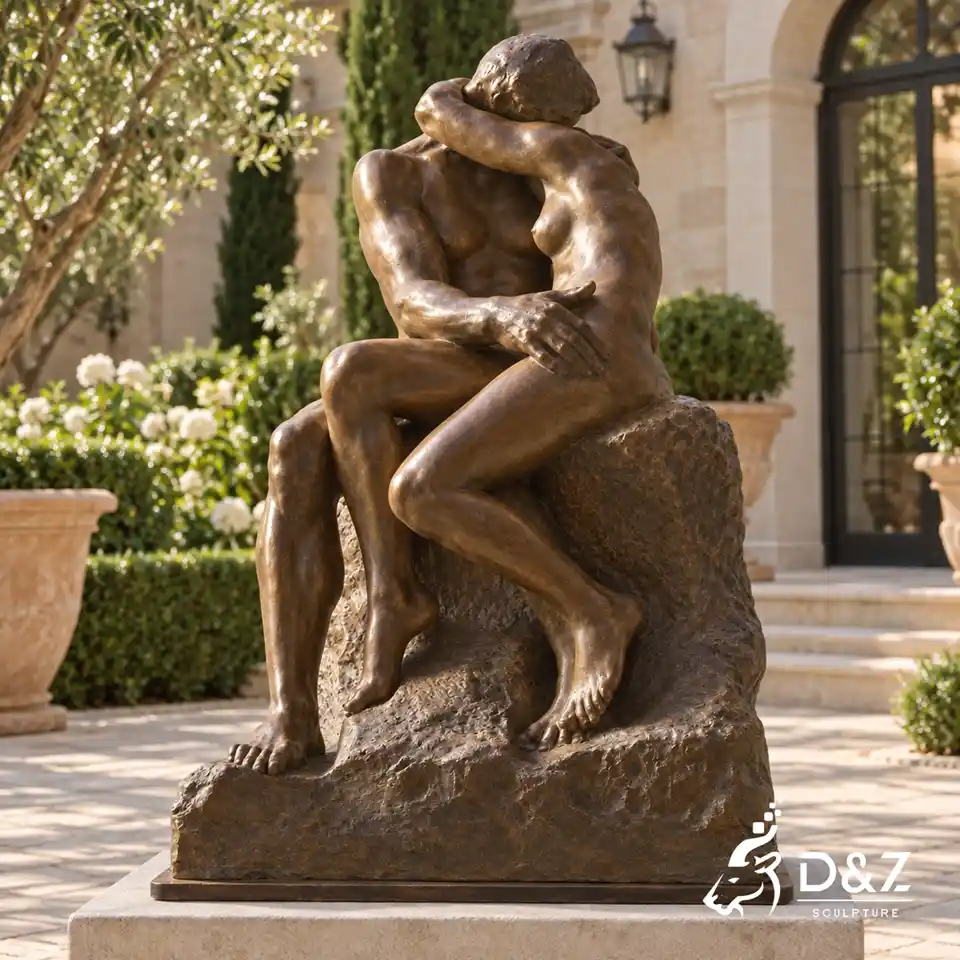
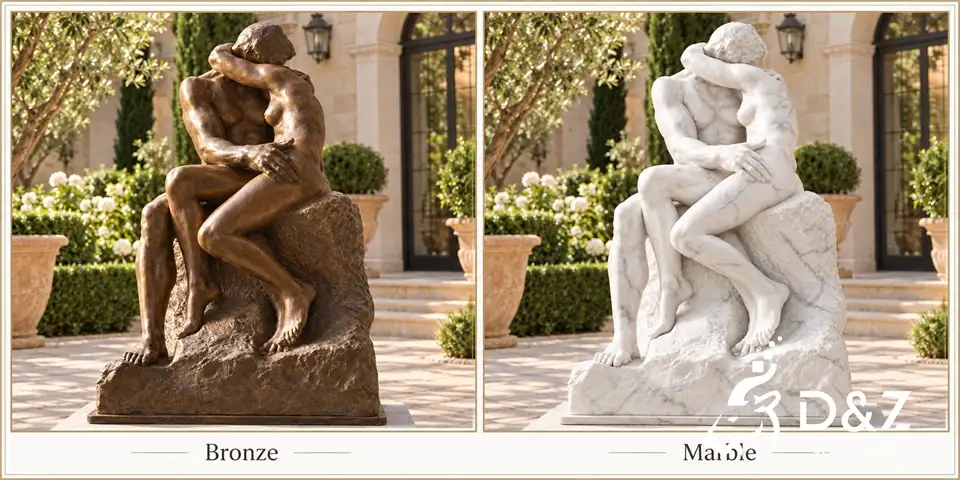
Both bronze and marble are available. Bronze offers a warm, monumental character with customizable patinas, while marble provides the classical appearance and refined surface associated with the historic the kiss marble sculpture.
More Kiss Sculpture Designs
Beyond Rodin-inspired and reproduction projects, D&Z Sculpture also develops a wide range of Kiss-Themed Sculptures, including:
- The kiss marble sculpture — classical lovers sculpture in natural marble
- Blowing kiss sculpture — contemporary figurative design with a playful gesture
- Cupid’s kiss sculpture — romantic sculpture inspired by classical mythology
- The kiss of death sculpture — dramatic and symbolic figurative sculpture
- Angel kiss sculpture — romantic angel figures for gardens and decorative spaces
- Coffee kiss sculpture — contemporary artistic design for commercial environments
- Kiss horse sculpture — equestrian-themed sculpture expressing intimacy and connection
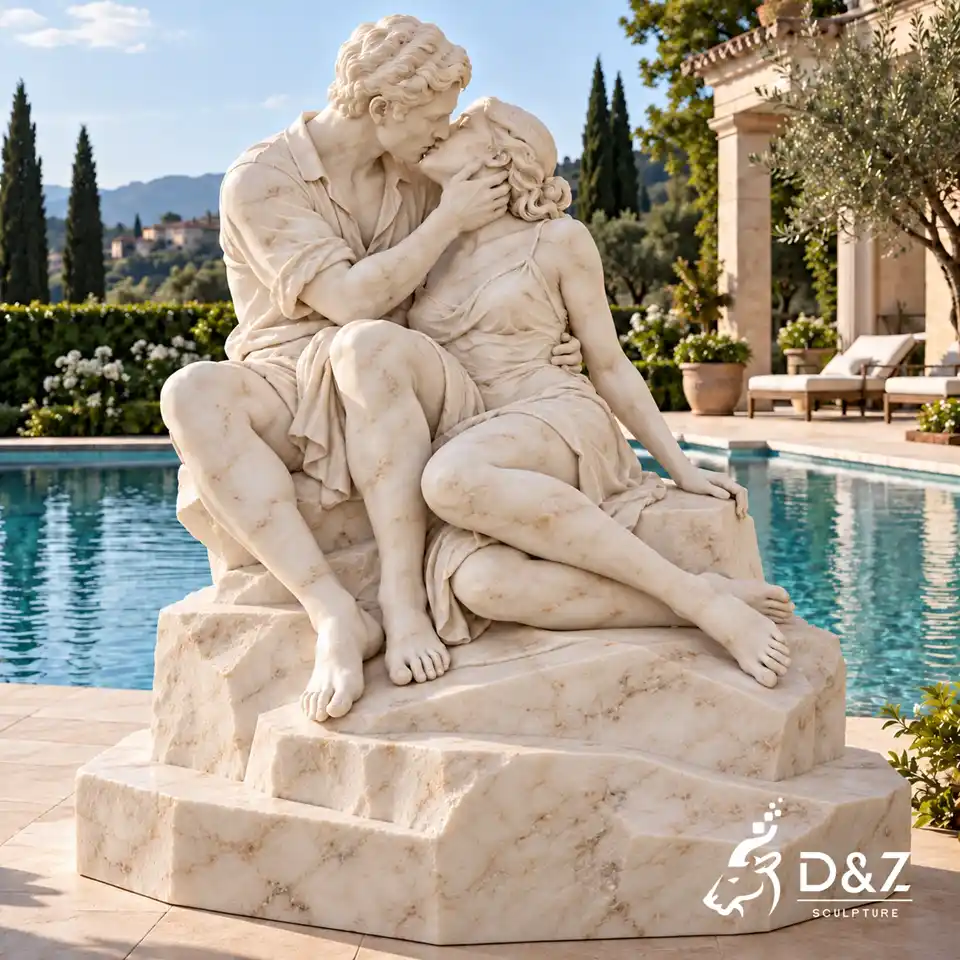

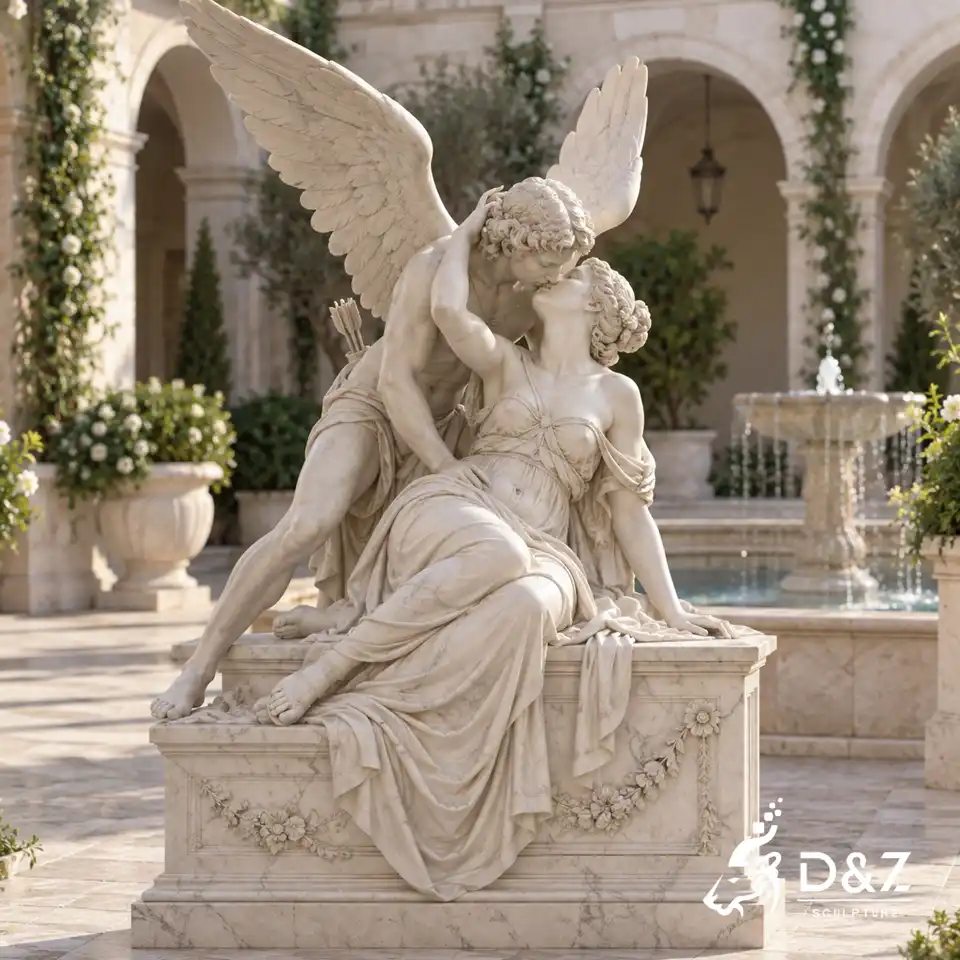
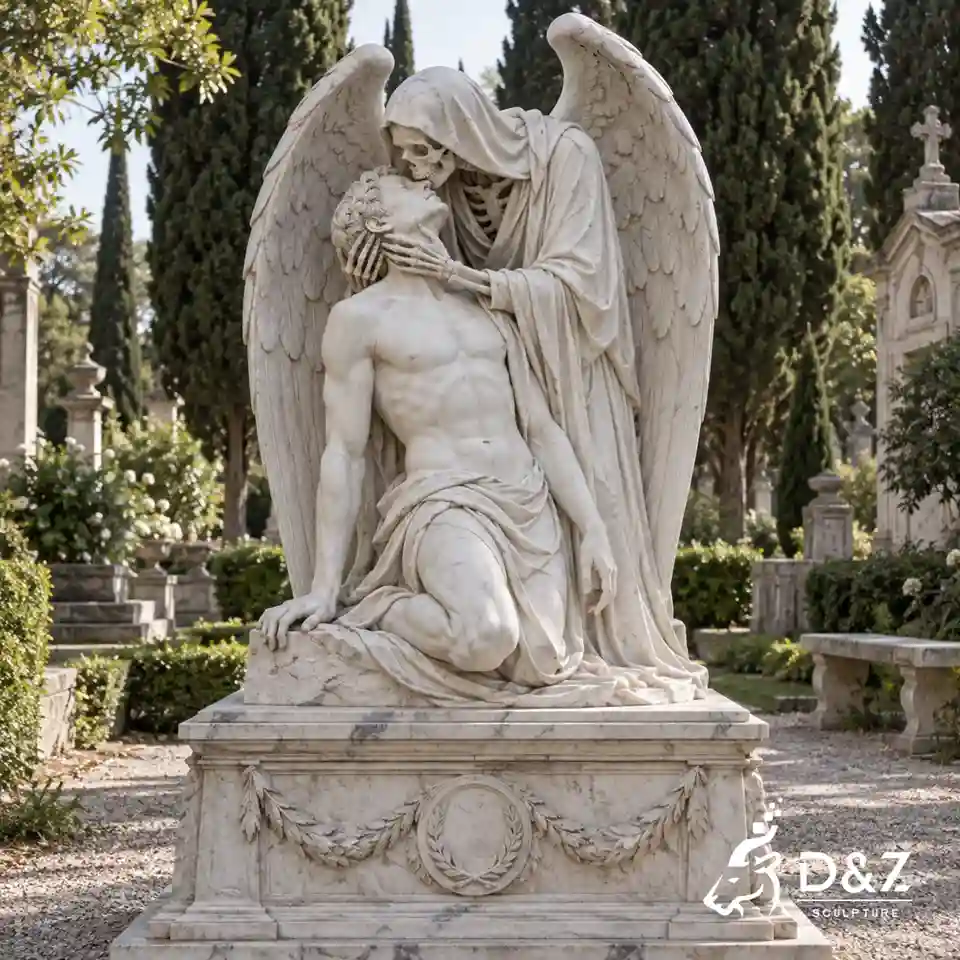
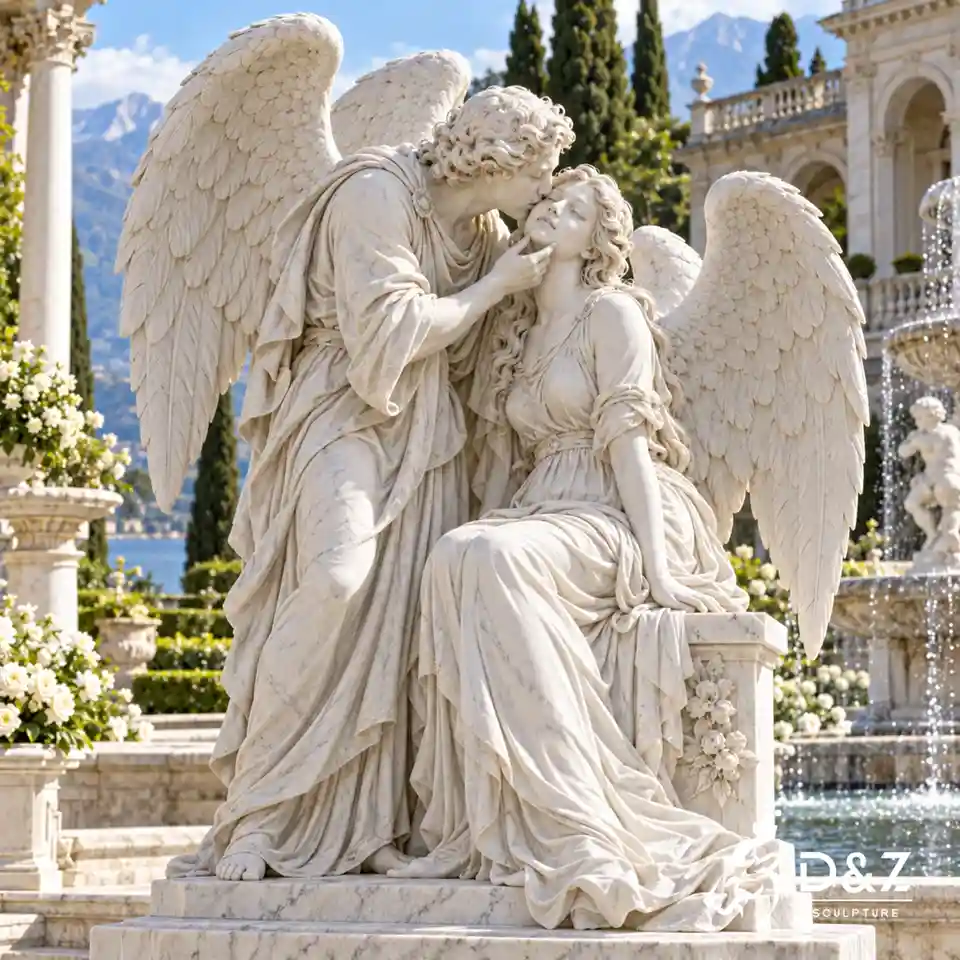
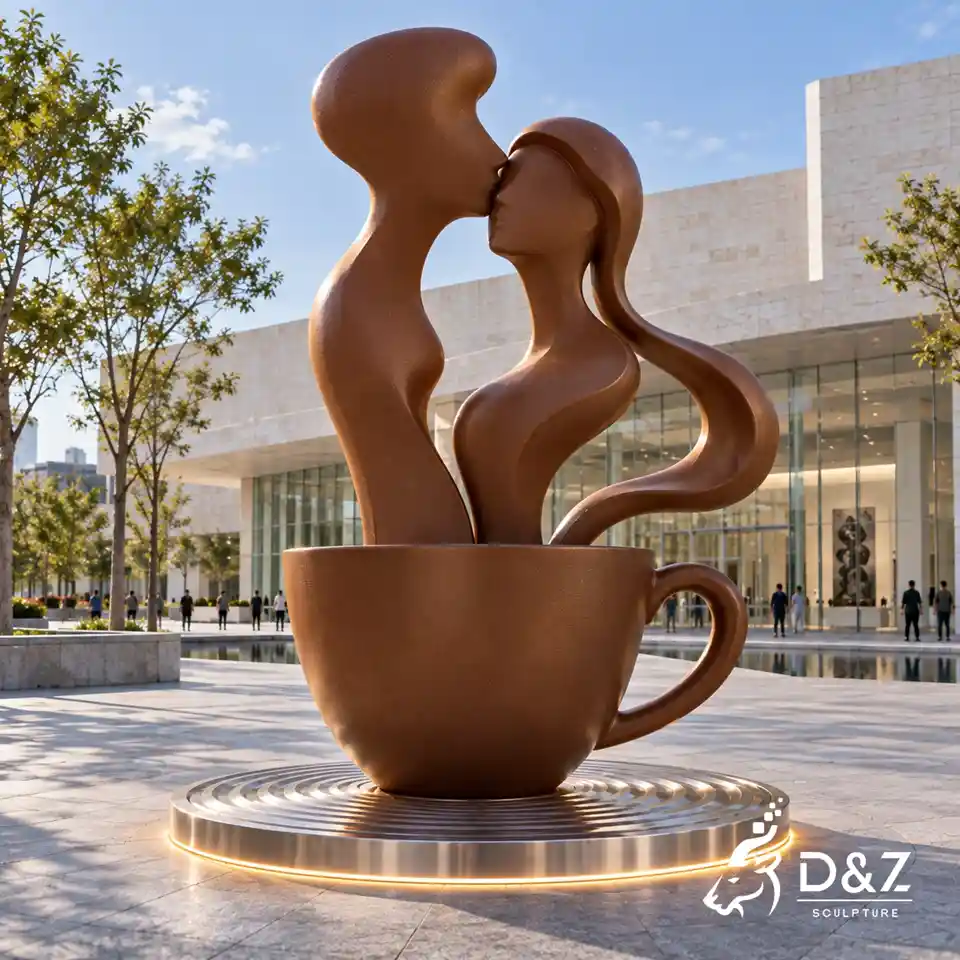
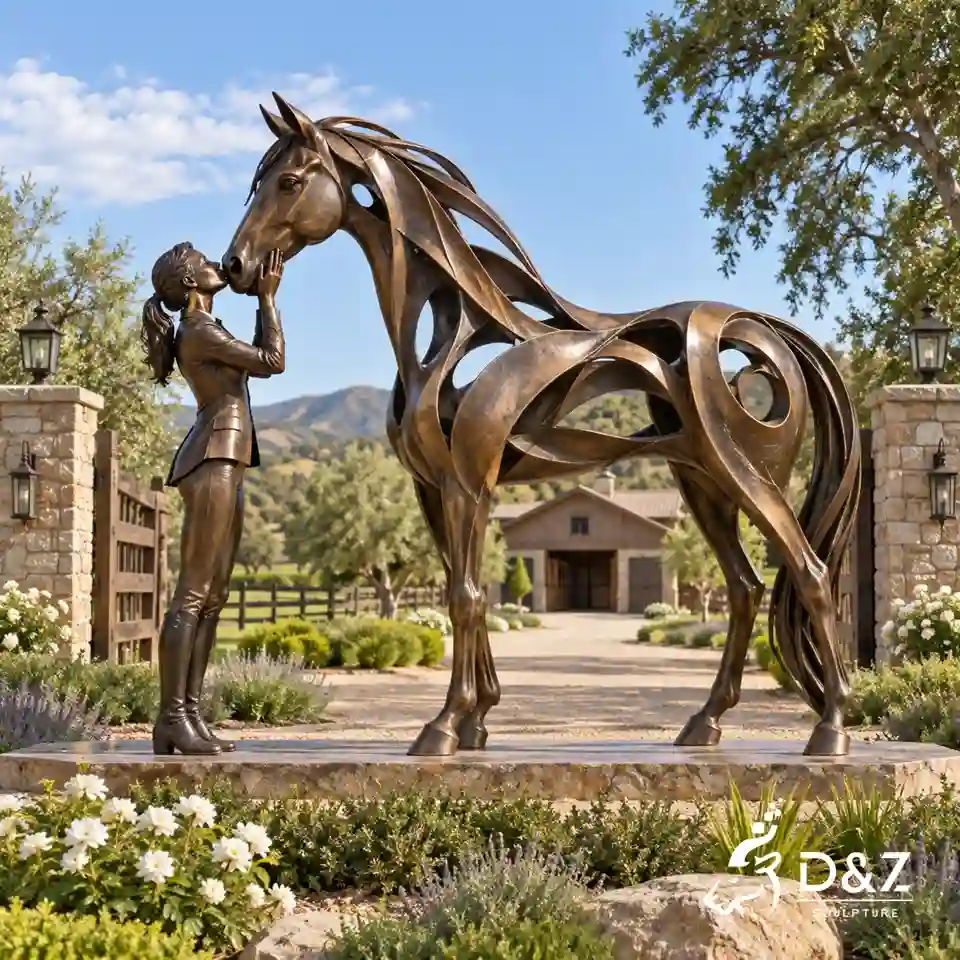
Each design can be customized in size, material, pose, color, pedestal, and installation structure for hotels, villas, gardens, resorts, commercial spaces, and public art projects.
D&Z Sculpture provides one-stop sculpture project solutions from design development and modeling to production, engineering, shipping, and installation.
How to Choose a Custom The Kiss Sculpture
Material and size are the two most important choices when planning a custom The Kiss sculpture.
Bronze vs. Marble
| Feature | Bronze | Marble |
|---|---|---|
| Visual Character | Warm, timeless, and monumental | Classical, elegant, and refined |
| Surface Appearance | Natural bronze, dark brown, golden bronze, or custom patina | Smooth, polished surface with natural stone veining |
| Detail Expression | Excellent for complex poses, deep undercuts, and fine details | Excellent for soft anatomy, facial details, and flowing body contours |
| Indoor Use | Yes | Yes |
| Outdoor Use | Excellent for long-term outdoor installation | Suitable outdoors with proper stone selection and maintenance |
| Weather Resistance | High, especially with proper patina and protection | Good, but more sensitive to staining, moisture, and weathering |
| Maintenance | Relatively low; periodic cleaning and surface care | Requires regular cleaning and protection from stains and deposits |
| Production Process | Clay Model → Mold → Lost-Wax Casting → Welding → Chasing → Patina | Stone Selection → Rough Carving → Detail Carving → Hand Polishing |
| Customization | Easy to customize pose, size, color, and internal structure | Customizable in pose, size, stone type, texture, and base design |
| Large-Scale Projects | Very suitable for monumental and public art projects | Suitable, but stone weight and structural support require more planning |
| Typical Applications | Gardens, resorts, plazas, hotels, public art projects | Villas, hotels, galleries, gardens, museums and classical interiors |
Bronze generally creates a stronger sense of permanence and is particularly practical for large outdoor projects.
Marble creates a softer classical atmosphere and is the material most closely associated with the famous monumental museum versions of The Kiss sculpture.
Choosing the Right Size
Small or medium versions work well in private interiors, studies and galleries where viewers can appreciate facial and hand details at close range.
Life-size sculptures are more suitable for hotel lobbies, wedding venues, villa gardens and landscaped courtyards.
For resorts, public parks, cultural plazas and large landscape projects, monumental versions create stronger visibility from a distance.
At D&Z Sculpture, the dimensions, material, pedestal, internal structure, and installation method can be customized according to the scale and viewing distance of the project.
FAQs About The Kiss Sculpture
Q: Who created The Kiss sculpture?
A: Auguste Rodin conceived it around 1882 while working on The Gates of Hell.
Q: What story inspired Rodin Sculpture The Kiss?
A: It was inspired by Paolo and Francesca, the tragic lovers from Dante’s Inferno.
Q: Is The Kiss sculpture romantic or tragic?
A: Both. The visible scene is romantic, while the story behind it ends in tragedy.
Q: What material is The Kiss sculpture made from?
A: The famous Paris monumental version is Carrara marble, while plaster and bronze versions also exist.
Q: Are there different sizes of The Kiss sculpture?
A: Yes. The composition exists in different models, marble versions, and bronze editions.
Q: Where is The Kiss sculpture located?
A: Major marble versions are associated with Musée Rodin in Paris, Tate in the UK, and the Ny Carlsberg Glyptotek in Copenhagen.
Q: Can I customize a bronze The Kiss sculpture?
A: Yes. It can be produced as a clearly identified custom reproduction or Rodin-inspired sculpture.
Q: Can a custom kissing statue be installed outdoors?
A: Yes. Bronze is particularly suitable for outdoor installations, while appropriate marble can also be used.
Q: How long does a custom Kiss sculpture take to make?
A: Production time depends on size, material, complexity, and surface treatment.
Q: Do you ship custom sculptures worldwide?
A: Yes. D&Z Sculpture provides international packing, shipping, and installation support.
Contact Us
More than a century after Rodin conceived Paolo and Francesca, The Kiss Sculpture remains powerful because it turns a brief human moment into a permanent sculptural form.
Its appeal comes not only from the kiss itself, but from the relationship between movement, touch, balance, surface, and emotion.
D&Z Sculpture is a manufacturing partner for large metal and bronze public art projects, providing one-stop sculpture project solutions from design development and modeling to engineering, fabrication, surface finishing, transportation, and installation.
Whether your project requires a classical marble lovers’ sculpture, a monumental bronze kissing sculpture, or an original contemporary design inspired by the emotional language of Rodin’s masterpiece, the size, material, pedestal, and installation structure can be customized for the project environment.
Contact D&Z Sculpture to discuss your custom kiss sculpture project.