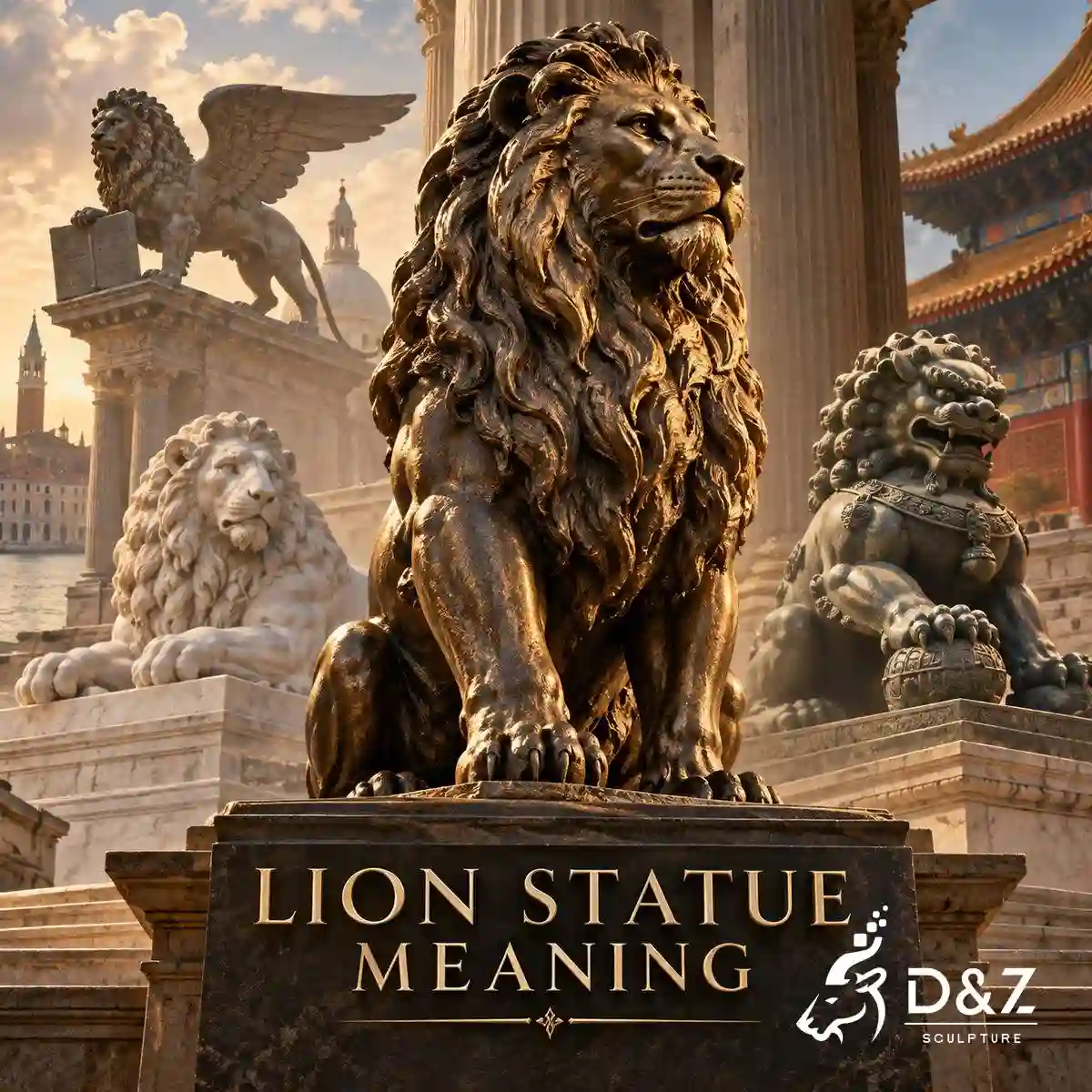
Lion statue meaning is commonly associated with strength, courage, protection, royalty, and prestige. When you travel to different countries, have you noticed lion statues standing outside palaces, temples, luxury homes, hotels, and public buildings? These sculptures have appeared across continents, civilizations, and centuries. Yet the same animal can carry very different meanings. Some lions represent royal authority, others guard sacred spaces, while some honor loyalty and sacrifice.
To understand the meaning of lion statues, you need to look beyond their powerful appearance. Their history, cultural background, posture, and location all help explain what they represent. Understanding lion statue meaning also helps you appreciate why different communities choose different lion sculptures. In this guide, we’ll explore lion symbolism around the world, including its cultural meanings, artistic styles, and traditional placement. We’ll also share practical advice to help you choose a lion sculpture that fits your space.
Table of Contents
01 | Lion Statue Meaning: Strength, Protection, and Prestige
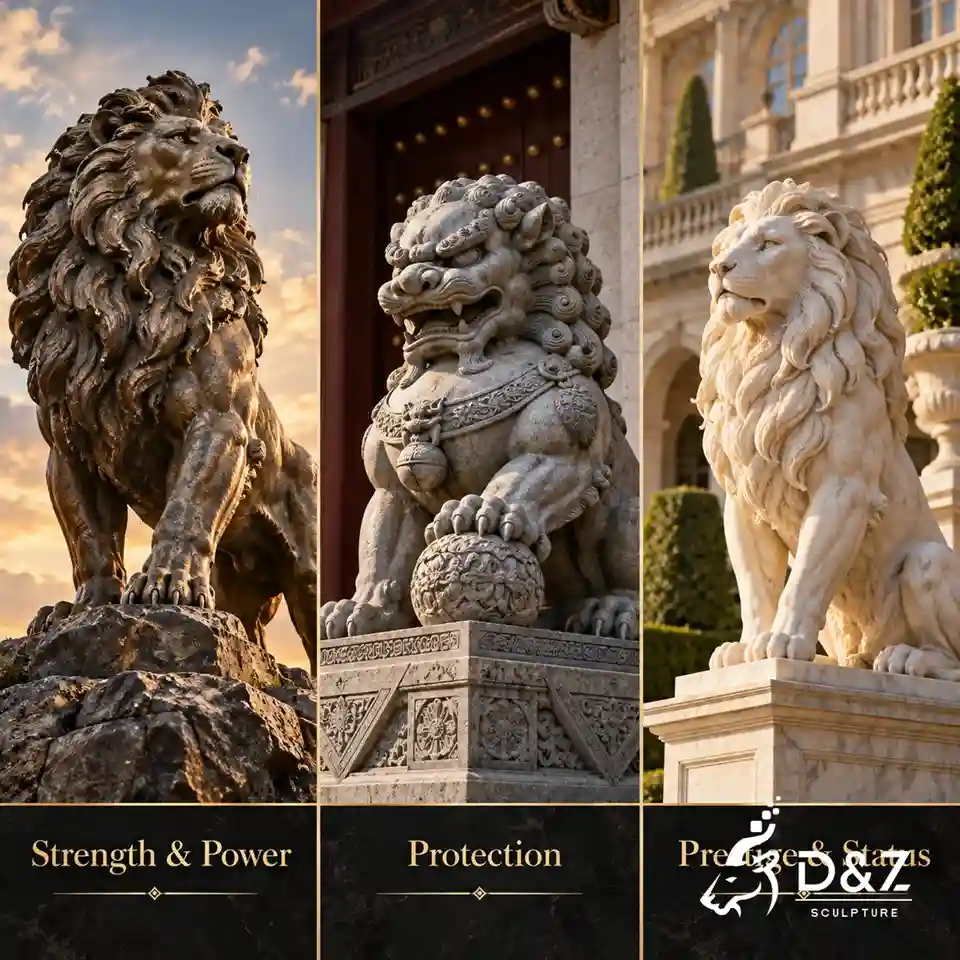
The most common lion sculpture meaning comes from the animal’s natural strength, courage, and commanding presence. Throughout history, people have used lion sculptures to express three main ideas: power, guardianship, and personal status. Although lion statue meaning varies across cultures, these three themes offer a useful starting point.
Strength, Power, and Courage
Often called the king of beasts, the lion is widely associated with strength, leadership, and fearlessness. Ancient rulers and powerful institutions used lion imagery to express their authority, determination, and ability to face danger. Rather than simply representing aggression, a lion statue can communicate controlled strength, dignity, and a commanding presence. This traditional connection between leadership and strength remains central to lion symbolism today.
Protection and Guardianship
One of the most familiar examples is a lion statue placed at a building entrance. For centuries, people have positioned these sculptures outside palaces, temples, and private residences as symbolic guardians. They were traditionally believed to protect important spaces from danger, unwanted visitors, and harmful spiritual influences.
Personal Identity, Prestige, and Status
A lion statue can also be a quiet expression of your achievements, identity, and personal taste. At a grand estate, villa, or private club, it may suggest confidence, success, and prestige. Today, the sculpture can reflect more than social status. Its material, artistic style, and placement also communicate your values and aesthetic preferences.
02 | The History and Origins of Lion Statues
Lion Sculptures in Ancient Civilizations
Lion imagery appeared in some of the world’s earliest civilizations, especially ancient Egypt and the Near East. Thousands of years ago, lions were already associated with rulers, deities, and protective powers. In Egypt, lion figures appeared in royal and religious art. In ancient Mesopotamia, monumental winged lions with human heads guarded Assyrian palace entrances, expressing both royal authority and supernatural protection. These early examples help explain the historical roots of lion statue meaning.
The Evolution of Lion Statues Across Civilizations
As trade, religion, and cultural exchange developed, lion imagery took on new forms. Ancient Greek artists connected lions with mythology and heroic achievements, while Roman artists used them in tombs, monuments, and architectural decoration. In Asia, lion imagery developed through both cultural exchange and the spread of Buddhism. China and Japan gradually created distinctive guardian lion traditions.
These traditions did not follow one simple route or develop at the same time. Each civilization adapted the lion to its own beliefs, artistic methods, and architectural needs. As a result, the meaning of lion statues became closely connected with local history and religious traditions.
From Ancient Guardians to Modern Decorative Art
In ancient societies, lion statues often served religious, royal, memorial, or protective purposes. Over time, their roles expanded into architecture, landscape design, and public art. Modern artists still preserve the lion’s powerful character, but they also explore realistic, abstract, geometric, and contemporary metal designs.
03 | Lion Statue Meaning in Different Cultures Around the World
You can find lion imagery in civilizations across the world, but its symbolism is not identical everywhere. Cultural traditions, religious beliefs, and local history have shaped the meaning and appearance of each type of sculpture. To fully understand lion statue meaning across cultures, you need to consider both the artistic design and the traditions behind it.
Chinese Lion Statue Meaning – Protection, Authority, and Prosperity
The Chinese lion statue, also known as a Chinese guardian lion or stone lion, is one of the most recognizable symbols in traditional Chinese architecture. Often called a foo dog statue in English, it is actually based on a lion rather than a dog. Lions became known in China through historical exchanges with regions to the west, while Buddhist art also influenced their development.
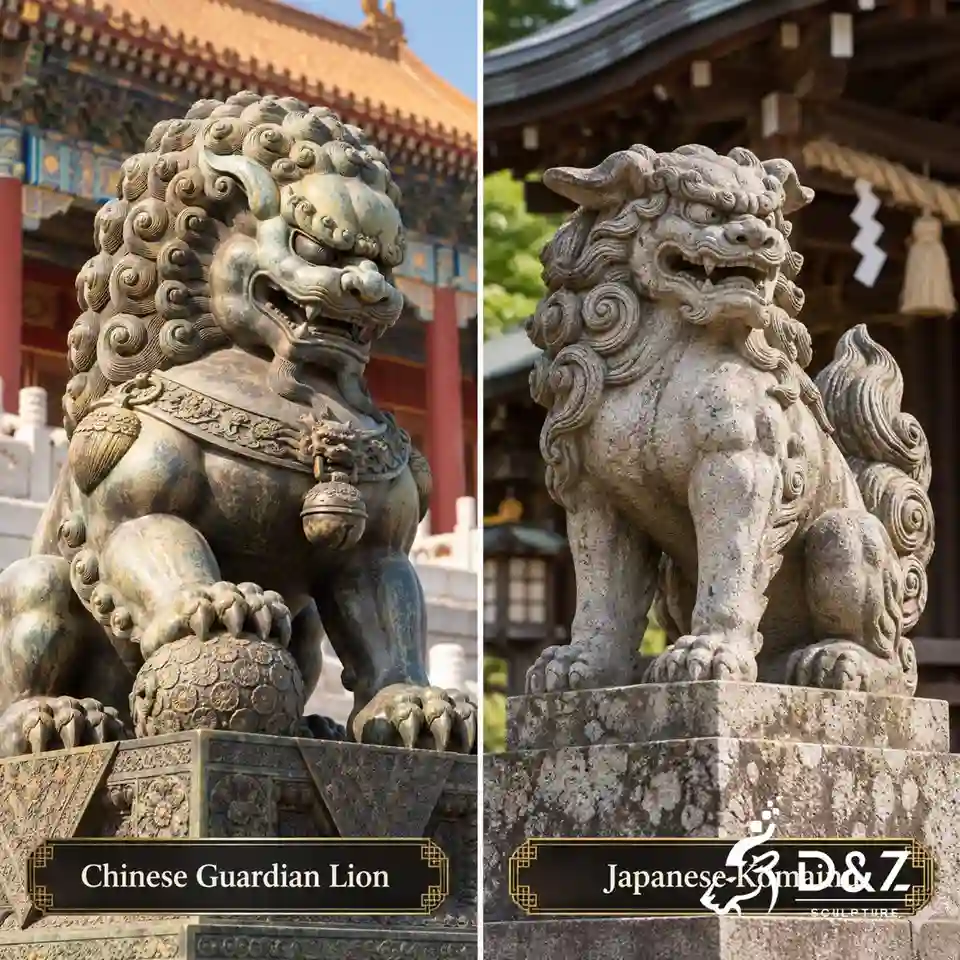
You will often see pairs of guardian lions outside palaces, temples, government buildings, and traditional residences. They symbolize authority, protection, good fortune, and family prosperity. Through centuries of artistic development, their curled manes, expressive faces, and powerful bodies became distinctive features of Chinese sculpture. These architectural traditions are essential to understanding Chinese lion statue meaning beyond its decorative appearance.
Japanese Lion Statue Meaning – Komainu and Sacred Protection
A Japanese lion statue, commonly known as a Komainu, often stands at the entrance to a Shinto shrine. These guardian figures are traditionally associated with protecting sacred spaces and keeping harmful spiritual influences away. Their history is connected to lion imagery that reached Japan through Buddhist and East Asian cultural exchanges.
Although Chinese guardian lions and Japanese Komainu share historical connections, they are not exactly the same. Japanese pairs often feature one open mouth and one closed mouth, traditionally associated with the sounds A and Un. Their forms may also include canine features. If you are choosing a sculpture for a Japanese-style shrine or garden, these cultural details matter. Japanese lion statue meaning is closely tied to these shrine traditions and the symbolic protection of sacred spaces.
Ancient Egyptian Lion Statue Meaning – Royal Power and Divine Protection
In ancient Egypt, lions were closely connected with royal power, the sun, and divine protection. Lion imagery was associated with several deities, including the fierce lioness-headed goddess Sekhmet. Linked to the sun god Ra, she represented destructive strength, warfare, protection, and healing.
The Great Sphinx of Giza is another famous example of Egyptian lion symbolism. Combining a human head with a lion’s body, it expresses royal power and divine authority. However, an ancient Egyptian lion statue, a sphinx, and a statue of Sekhmet are different artistic subjects, each with its own historical meaning.

Greek and Roman Lion Statues – Strength and Heroism
In Greek mythology, the Nemean Lion is closely connected with Heracles and his legendary Twelve Labors. By defeating the powerful animal, the hero demonstrated exceptional courage and strength. Lion imagery therefore became associated with heroic achievement, bravery, and victory.
Greek and Roman artists also used lion sculptures in temples, tombs, fountains, and public monuments. Depending on the context, they could express protection, honor, strength, or remembrance. These classical designs later influenced European architectural sculpture.
European Lion Statues – Royalty, Nobility, and Heraldry
In medieval and later European traditions, lions frequently appeared on royal coats of arms, flags, and noble family emblems. Their strength and commanding appearance made them powerful symbols of courage, authority, and noble identity.
You can also find lion sculptures at castle gates, palace entrances, and historic estates. In heraldry, a lion’s posture carries a specific visual description, such as a standing or rearing lion. However, the exact meaning depends on the history of the family, region, or institution rather than one universal rule.
Italian Lion Statue Meaning – The Winged Lion of Venice
Among Italian lion statues, the Winged Lion of Saint Mark is one of the most recognizable cultural symbols. Found throughout Venice, this winged lion represents Saint Mark the Evangelist and the city’s historic religious and political identity.
A traditional Venice lion statue often features wings and a book, although other variations also exist. During the Venetian Republic, the image appeared on public buildings, monuments, and official symbols. It reflects religious authority, civic identity, and the city’s maritime history. This is a specific Venetian tradition, not the meaning of every lion sculpture in Italy.
African Lion Symbolism – Leadership, Strength, and Royal Authority
Lion symbolism varies across African cultures. In some traditions, lions are associated with leadership, military strength, and royal authority. For example, the lion was a personal emblem of King Glele of Dahomey, in present-day Benin. Lion imagery could also connect royal descendants and allies with political power.
An African lion statue may therefore communicate strength or leadership, but its meaning should be understood through the specific culture and artwork. African artistic traditions are highly diverse, and lions are not equally important in every community.
Indian Lion Statue Meaning – Hinduism and Royal Authority
In Hinduism, Narasimha is the man-lion incarnation of Vishnu. According to Hindu tradition, he defeats a destructive ruler and restores order, representing divine protection, courage, and the victory of good over evil.
Another important Indian lion statue is the Lion Capital of Ashoka at Sarnath. Its four lions stand back to back, reflecting the authority of the Mauryan ruler and the Buddhist historical context of the monument. The design later became the basis of India’s national emblem.
Lion Symbolism in Buddhism – Spiritual Strength and Protection
In Buddhism, the lion is closely associated with spiritual authority and the power of the Buddha’s teachings. The expression Lion’s Roar describes the fearless and powerful proclamation of the Dharma. Lions also appear in Buddhist art as guardian figures and as mounts associated with certain bodhisattvas, including Manjushri.
Within this tradition, lion imagery can represent wisdom, spiritual courage, and the protection of sacred teachings. These meanings differ from the royal and decorative uses of lion sculptures in other cultures.
Cultural Note: Quebec’s Mortgage-Free Lion Tradition
In parts of Quebec, Canada, a local tradition associates placing one or two lion statues outside a house with paying off the mortgage. The sculptures serve as symbols of personal achievement, homeownership, and pride. This custom is reported in local real estate traditions, although it is not practiced by every homeowner.
04 | What Do Different Lion Statue Poses Mean?
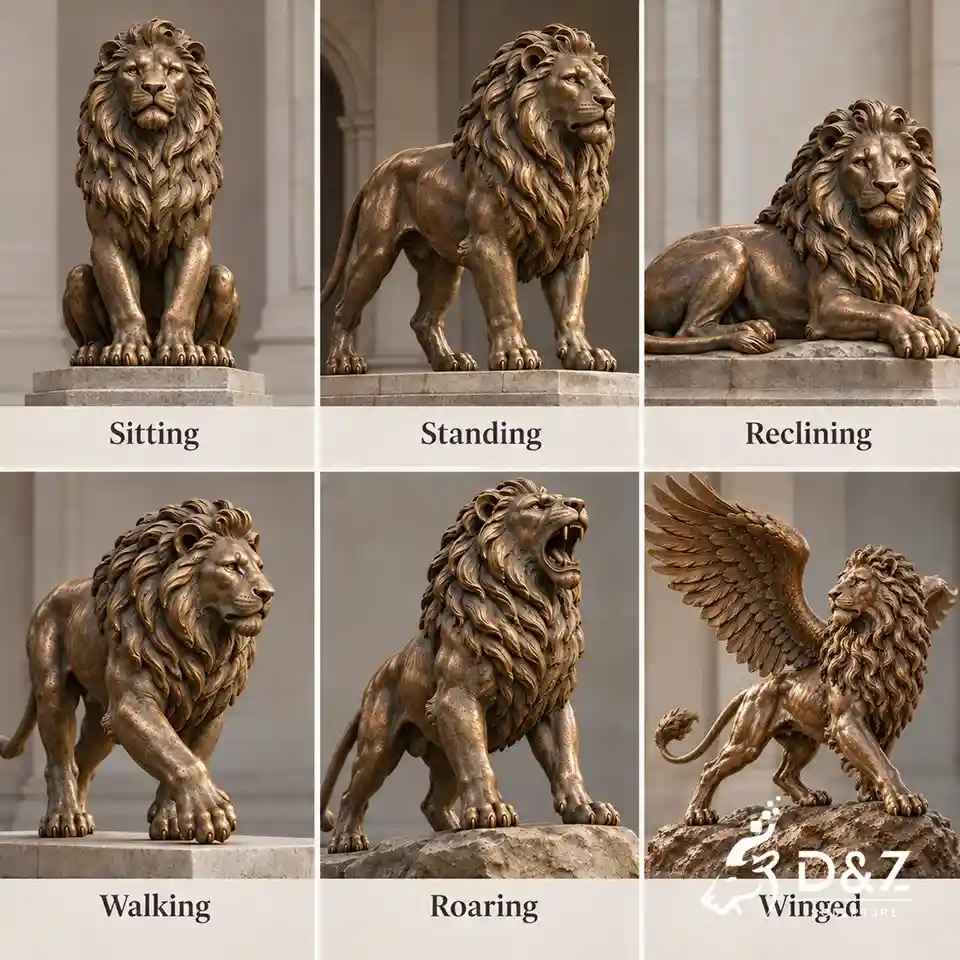
Lion statues come in many poses, and each design creates a different impression. Although there is no single universal meaning for every pose, artists often use posture, facial expression, and movement to communicate specific qualities. Lion statue meaning can therefore change depending on whether the animal appears calm, alert, moving, or roaring.
Sitting Lion Statue Meaning
A sitting lion statue often represents stability, dignity, alertness, and controlled strength. Its upright posture creates a calm but watchful presence, making it one of the most popular designs for formal entrances, gardens, and estate gates. If you want a traditional guardian appearance, this is a practical choice. For residential projects, sitting lion statue meaning is often associated with watchful protection and a sense of security.
Standing Lion Statue Meaning
A standing lion conveys confidence, readiness, and authority. Its strong body and upright stance create a more active impression than a seated design. It works particularly well at grand entrances, public squares, and large estates.
Reclining Lion Statue Meaning
A reclining lion suggests calmness, dignity, and strength at rest. The animal appears peaceful without losing its powerful character. This design is especially suitable for memorial gardens, parks, and quiet architectural settings.
Walking Lion Statue Meaning
A walking lion expresses movement, determination, and confidence. Its forward motion can suggest progress, ambition, and the courage to explore new opportunities. You can consider this pose for corporate landscapes, modern developments, and public art projects.
Roaring Lion Statue Meaning
A roaring lion emphasizes bravery, intense strength, and a commanding presence. Its open mouth and expressive posture create a powerful visual impact. It is suitable when you want a bold sculpture that communicates determination and protection.
Winged Lion Statue Meaning
A flying lion statue, or winged lion sculpture, should be interpreted within its cultural setting. Wings may introduce spiritual or mythological associations, but they do not have one fixed meaning. The Winged Lion of Saint Mark, for example, represents Venice’s religious and civic identity.
05 | What Does a Pair of Lion Statues Symbolize?
Why Are Lion Statues Placed in Pairs?
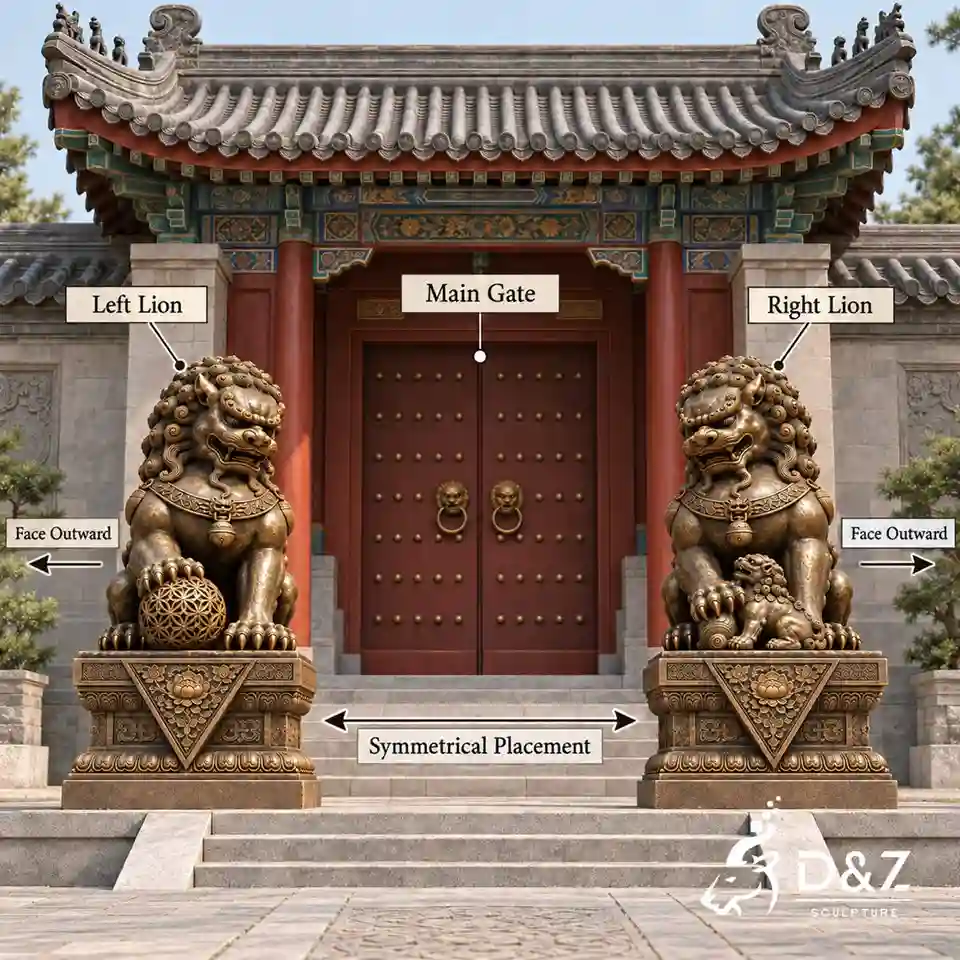
Placing lion statues in pairs creates visual balance and a strong sense of guardianship. In many traditional buildings, one sculpture stands on each side of the entrance, forming a symmetrical arrangement. This design combines architectural beauty with the symbolic idea of protecting an important space. The meaning of lion statues displayed in pairs can also reflect local customs and architectural traditions.
Male and Female Guardian Lion Statue Meaning
In traditional Chinese guardian lion pairs, the male often places a paw on an embroidered ball, while the female is shown with a cub. The male is associated with authority and protection of the wider domain, while the female represents family, descendants, and care for the household.
A common traditional arrangement places the male on the building’s left and the female on its right when viewed from inside looking outward. If you stand outside facing the entrance, the positions appear reversed. Regional practices and individual designs may vary.
Lion With Ball Statue Meaning
The lion with ball statue meaning comes mainly from Chinese guardian lion traditions. The embroidered ball beneath the male lion’s paw can represent the world, authority, and control. The cub beneath the female lion suggests family continuity, protection, and future generations.
Together, these details make the pair a powerful symbol of both public authority and private family life. This traditional lion symbolism helps explain why the ball and cub remain popular details in Chinese guardian lion designs.
06 | Why Are Lion Statues Placed in Front of Houses and Important Buildings?
You may wonder why lion statues appear so often at entrances. Beyond their traditional protective meaning, they create a strong first impression and help express the identity of a building. The intended message changes depending on where the sculpture is placed. This is why lion statue meaning often connects cultural symbolism with the practical role of architectural decoration.
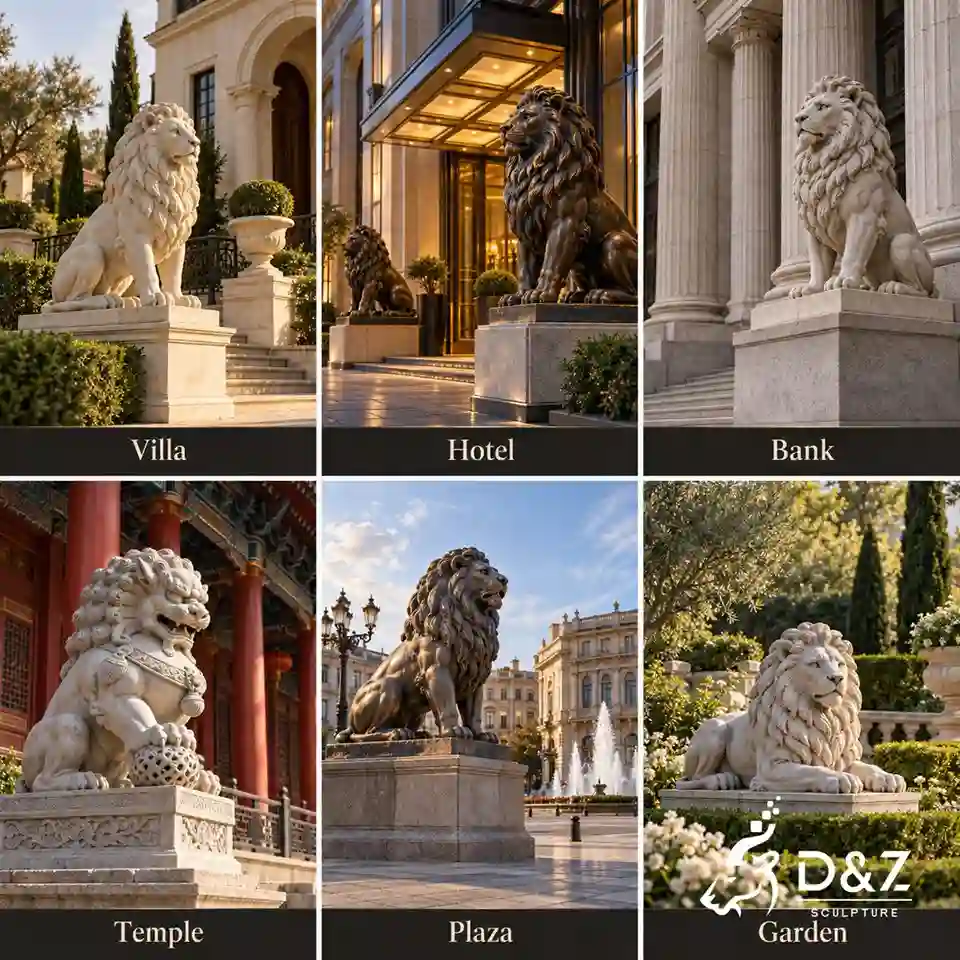
Lion Statues in Front of Houses and Gardens
The lion statue in front of house meaning is usually connected with protection, security, confidence, and personal achievement. A pair of lions at a villa entrance can make the property feel more formal and welcoming, while a single sculpture can become a focal point in the garden.
If you are considering a lion statue for your home entrance, think about the message you want to express. A seated marble pair offers a classical appearance, while a modern metal lion can create a more contemporary impression. For a lion statue at a home entrance, its meaning should complement the architectural style and the atmosphere you want to create.
Lion Statues at Hotels and Luxury Resorts
At a hotel or resort entrance, lion sculptures can create an impressive arrival experience. Their scale, material, and artistic style communicate prestige and help establish the property’s visual identity. For a luxury project, the sculpture should complement the building rather than overpower it.
Lion Statues at Banks and Corporate Buildings
Banks, financial institutions, and corporate headquarters may use lion sculptures to express stability, confidence, and institutional strength. A carefully designed sculpture can reinforce an impression of reliability while giving the entrance a distinctive architectural character.
Lion Statues at Temples, Palaces, and Government Buildings
In traditional architecture, lion statues often carry historical, ceremonial, or religious meanings. At palace gates, they may represent royal authority. At temples and sacred buildings, they can serve as symbolic guardians. Their role is closely tied to the local culture and the history of the site.
Lion Statues in Public Squares and Memorial Spaces
In city squares, parks, and memorial sites, lion sculptures can honor historic events, courageous individuals, and collective memories. They may also become recognizable landmarks that connect a community with its cultural identity.
07 | Do Lion Statues Bring Good Luck? Traditional Beliefs and Feng Shui
With so many lion statues guarding entrances around the world, you may ask whether they really bring good luck. The answer depends on cultural beliefs rather than scientifically proven effects.
Are Lion Statues Symbols of Good Luck?
In several cultural traditions, lion statues are considered symbols of protection, prosperity, and good fortune. People may place them near their homes because they believe these figures bring positive meaning and offer spiritual reassurance. Their symbolic value can remain important even without measurable effects.
Lion Statues in Feng Shui Traditions
In traditional Chinese feng shui beliefs, guardian lions are associated with protecting entrances and resisting unfavorable influences. They are often placed outside important buildings as symbolic defenders. These interpretations belong to cultural and spiritual traditions, not established scientific principles.
Traditional Guardian Lion Placement
Traditional Chinese guardian lions are commonly installed in pairs, with their faces directed outward from the entrance. If you prefer a classical arrangement, choose matching proportions and enough space around each sculpture. For contemporary projects, you can adapt the layout to the architecture while respecting any cultural details that are important to you.
08 | Famous Lion Statues Around the World and Their Meanings
Some of the world’s most famous lion sculptures carry meanings far beyond power or wealth. They preserve national history, celebrate resilience, or remember people who lost their lives. These landmarks demonstrate how lion statue meaning can reflect the history and values of an entire community.
Trafalgar Square Lions, London
Four monumental bronze lions sit at the base of Nelson’s Column in London’s Trafalgar Square. Created by Sir Edwin Landseer and installed in 1867, they form part of a memorial honoring Admiral Horatio Nelson. The sculptures reflect courage, commemoration, and Britain’s naval history.
New York Public Library Lions, USA
The famous NYC library lion statues are known as Patience and Fortitude. These two Tennessee marble lions have guarded the library’s Fifth Avenue entrance since 1911. Their names, popularized during the Great Depression, represent the patience and courage needed to overcome difficult times.
Lion Monument, Lucerne, Switzerland
The Lion Monument in Lucerne depicts a dying lion carved into a rock face. Completed in 1821, it commemorates Swiss Guards who died during the French Revolution in 1792. Unlike powerful entrance guardians, this sculpture expresses loyalty, sacrifice, grief, and remembrance.
Lion Capital of Ashoka, India
The Lion Capital of Ashoka at Sarnath features four lions standing back to back. It connects the authority of the Mauryan Empire with the historical spread of Buddhism. Its design was later adopted as the basis of India’s national emblem, making it an important symbol of the country’s heritage and identity.
09 | Lion Statue Meaning in Modern Art and Architectural Design
From Traditional Symbols to Contemporary Art
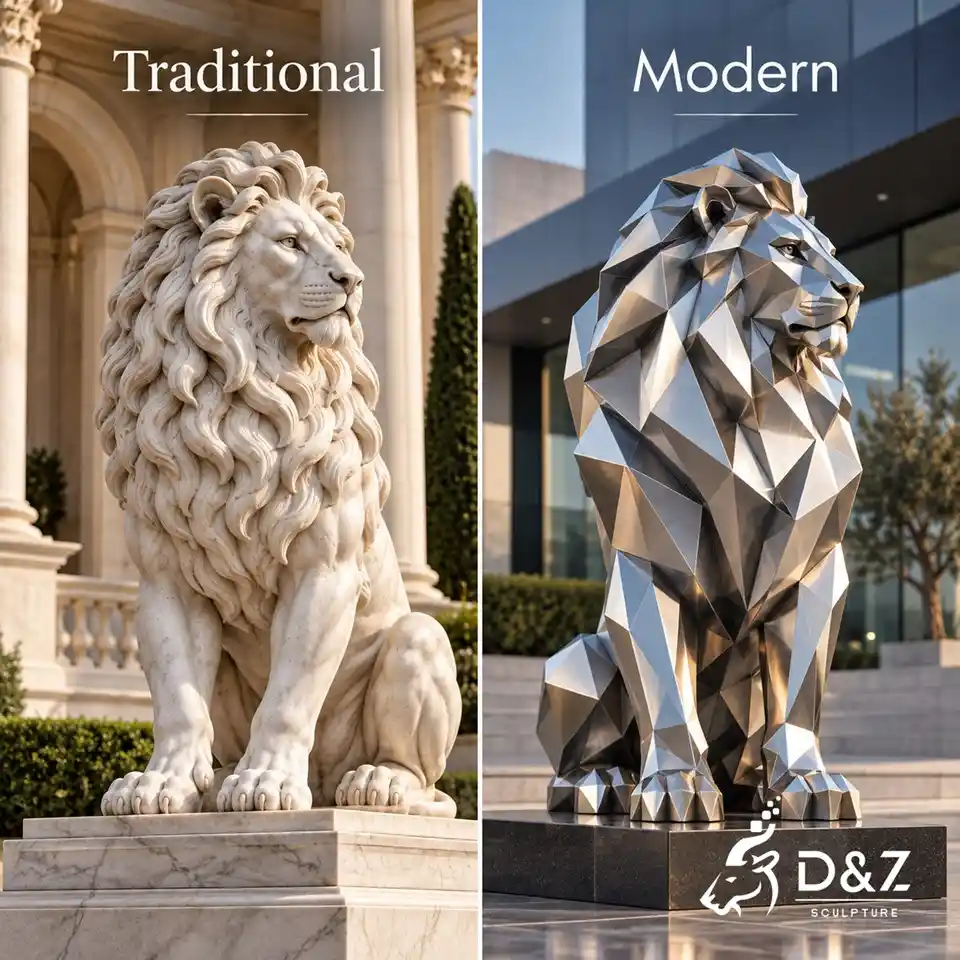
Today, lion sculptures are no longer limited to royal, religious, or protective roles. Artists use realistic forms, abstraction, geometric surfaces, and modern metal finishes to reinterpret the animal. The lion’s original strength remains recognizable, but the artistic expression is more flexible. In modern design, lion statue meaning can also reflect creativity, individuality, and personal artistic expression.
Enhancing Architecture and Landscape Design
A well-designed lion sculpture can become the visual center of a garden, hotel entrance, commercial plaza, or public landscape. Its shape, scale, and placement can strengthen the architectural character and help create a memorable environment.
Expressing Personal Taste and Artistic Identity
You can choose from classical marble lions, traditional bronze guardians, minimalist metal forms, or geometric stainless steel designs. Each style creates a different atmosphere. The right sculpture should reflect both your artistic preferences and the character of the surrounding space.
10 | How to Choose the Right Lion Statue for Your Space
If you are planning to buy a lion statue, start with its meaning and intended location rather than choosing only by appearance. As a custom sculpture manufacturer, we recommend considering four factors: style, size, material, and placement. Understanding lion statue meaning before choosing a design can help you select a sculpture that reflects your intended message.
Choose a Style Based on Its Meaning
For a traditional guardian entrance, a seated, realistic lion is a reliable choice. For memorial gardens, a reclining design can create a calm and respectful atmosphere. If your project is a modern commercial space, an abstract or geometric lion may fit the architecture better.
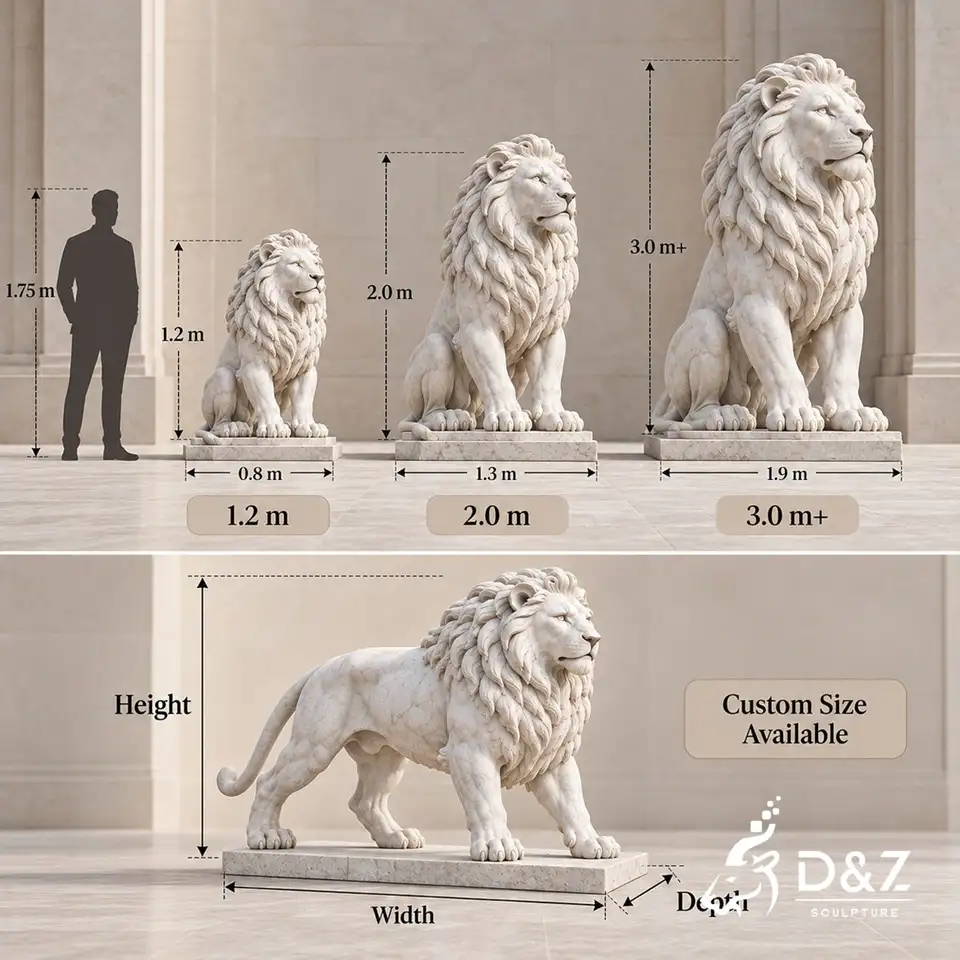
Choose the Right Lion Statue Size
The right size depends on your entrance width, building height, viewing distance, and landscape proportions. A sculpture that is too large can overwhelm a small entrance, while one that is too small may lose its visual impact in an open plaza.
For large outdoor projects, we recommend reviewing the site dimensions, pedestal design, structural requirements, and installation access before confirming the final size. A professional manufacturer can help adjust the sculpture’s proportions to fit your project.
Compare Lion Statue Materials
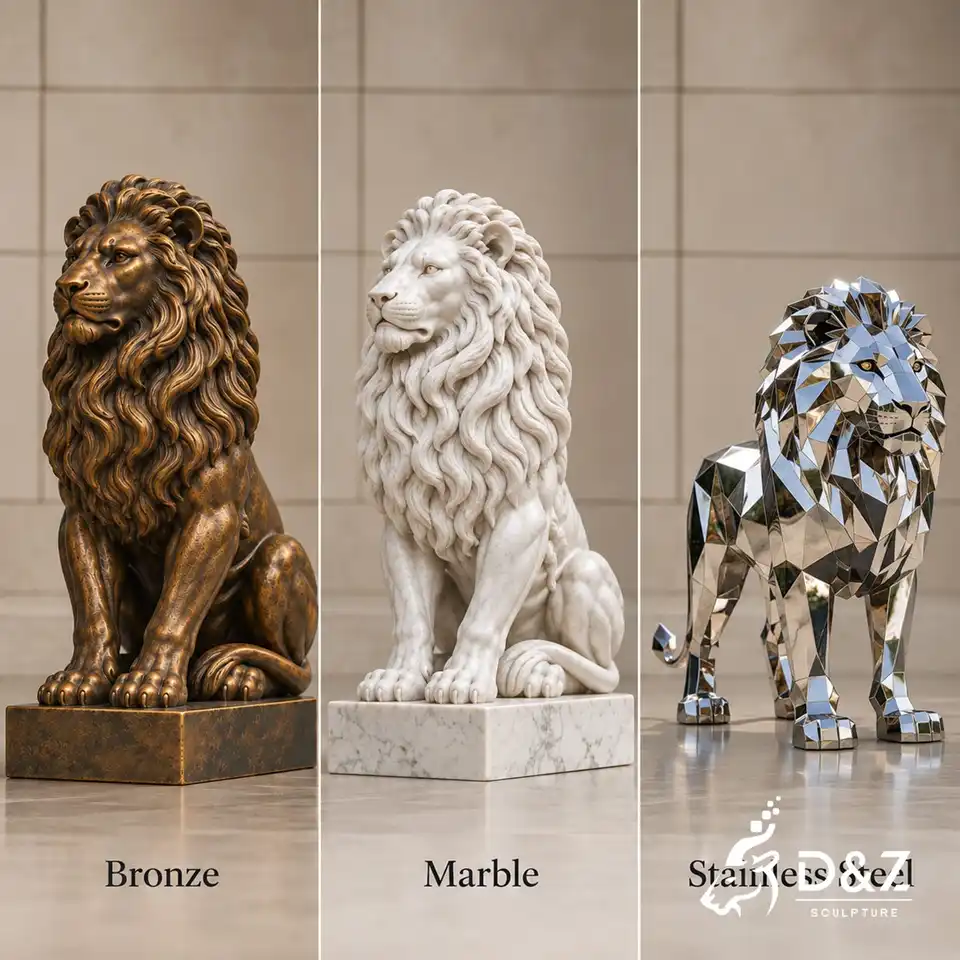
Material affects not only appearance but also durability, maintenance, and the way the sculpture fits its surroundings. The table below compares three common options.
| Material | Appearance | Applications | Maintenance |
|---|---|---|---|
| Bronze | Rich, classic, and substantial | Estates, hotels, monuments, outdoor gardens | Periodic cleaning; finish care as needed |
| Marble | Elegant, natural, and detailed | Traditional buildings, villas, gardens, interiors | Cleaning and protection from staining or weathering |
| 304/316 Stainless Steel | Modern, polished, brushed, or painted | Commercial plazas, hotels, modern landscapes | Routine cleaning; grade and finish depend on exposure |
For coastal or high-salt environments, 316 stainless steel is generally preferable to 304, although surface treatment, fabrication quality, and ongoing maintenance still matter. Bronze and marble can also be used outdoors when their design, finish, and maintenance plan suit the environment.
Select the Best Placement
You can place lion statues at main entrances, driveways, gardens, hotel lobbies, courtyards, or public squares. Outdoor installations should account for rain, temperature changes, wind, salt exposure, drainage, and foundation conditions. For large sculptures, the internal support structure and anchoring system must also be reviewed.
Before making a final decision, share your project photos, available space, preferred style, and approximate dimensions with your sculpture manufacturer. This helps turn an attractive design into a practical installation.
11 | Common Misconceptions About Lion Statue Symbolism
Lion statue meaning is sometimes simplified into a few universal ideas, but cultural context can completely change how a sculpture is interpreted.
Do All Lion Statues Have the Same Meaning?
No. The meaning of lion statues changes with cultural background, historical period, posture, and artistic purpose. A Chinese guardian lion, an Egyptian sphinx, and a European memorial lion should not be interpreted in exactly the same way.
Are Chinese Guardian Lions and Japanese Komainu the Same?
They share historical connections, but their artistic forms and cultural roles developed differently. Chinese guardian lions are strongly associated with traditional buildings and auspicious protection, while Komainu are especially connected with Japanese shrine traditions.
Must Lion Statues Always Be Displayed in Pairs?
No. Pairs are common in certain architectural and cultural traditions, but they are not required for every lion sculpture. A single lion can work well in a garden, memorial, or contemporary public art installation.
Do Lion Statues Represent Only Power and Wealth?
Not at all. They can also express loyalty, courage, spiritual protection, grief, sacrifice, family continuity, or modern artistic identity. Their meaning is much broader than power or financial success.
12 | Where to Buy High-Quality Lion Statues
If you are looking for a high-quality lion sculpture, we recommend working directly with a professional sculpture manufacturer. Beyond the appearance, you should evaluate material quality, craftsmanship, structural stability, outdoor durability, and installation requirements. When you buy a lion statue, choosing a manufacturer with experience in large architectural sculptures can help you address design and installation challenges.
At D&Z Sculpture, we specialize in large custom metal and bronze sculptures and provide one-stop solutions for public art and architectural projects. With over 30 years of manufacturing experience, we support projects from design development and fabrication to packaging, international shipping, and installation guidance. We also offer different lion sculpture styles and material options to suit your project.
Whether you are planning a pair of entrance lions for a hotel, a marble lion for a villa, or a monumental bronze sculpture for a public square, you can contact us to discuss your design, size, material, and project requirements.
13 | FAQs About Lion Statue Meaning
14 | Conclusion: The Timeless Meaning of Lion Statues
From ancient Egyptian temples and Chinese palace gates to European castles, modern hotels, and public parks, lion sculptures have crossed civilizations and centuries. Their lasting appeal comes from their ability to communicate strength, courage, protection, and prestige. Yet their exact meaning continues to change with culture, artistic design, and location. Lion statue meaning is therefore not limited to one tradition; it continues to evolve with the people and places connected to each sculpture.
If you are looking for a lion sculpture for your project, the best choice is one that combines meaningful design with the right material, scale, and setting. At D&Z Sculpture, we offer traditional, realistic, and contemporary lion sculpture designs, along with custom manufacturing solutions for large architectural and landscape projects. Explore your custom sculpture options with our team.